Professional Licence in Dubai: Activities, Ownership, Documents and Costs
Learn which activities a Dubai professional licence can cover, ownership and legal-form considerations, documents, approvals, setup steps and cost factors.
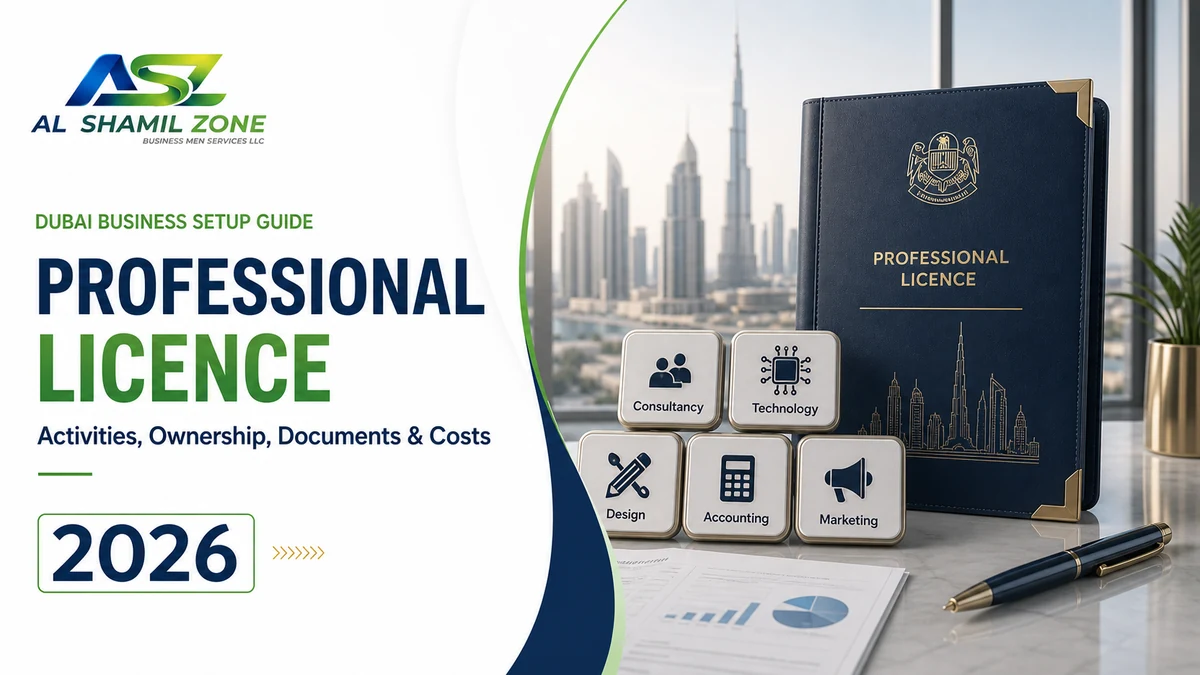
A Dubai professional licence is intended for businesses whose main output is expertise, knowledge or a specialised service rather than the sale of goods. It can suit consultants, designers, technology specialists and other service providers, but the exact activity—not the word “professional”—determines the approvals, qualifications and legal structure required.
What is a professional licence in Dubai?
Official UAE guidance recognises professional licensing as a distinct business-licence category. A professional licence authorises the activities printed on the licence; it does not give a business unrestricted permission to provide every type of consultancy or service.
The licence category and the legal form are separate decisions. A professional activity may be operated through an establishment, civil company, limited liability company or another form accepted by the relevant authority. The suitable form depends on ownership, liability, number of partners and activity rules.
Which activities can be professional?
Depending on the current Dubai activity list and external approvals, professional activities can include:
- management and business consultancy;
- information technology and software consultancy;
- marketing, communications and design services;
- technical, project and specialised advisory services;
- accounting and bookkeeping support;
- training and educational support activities;
- translation, research and administrative services; and
- other knowledge-based or skilled services recognised by the authority.
Descriptions are not interchangeable. For example, management consultancy does not automatically cover regulated legal, financial, investment, audit, engineering, medical or real-estate advice.
Activities that commonly need external approval
Additional approval, qualifications or professional registration can apply to:
- legal consultancy and advocacy;
- audit and regulated accounting services;
- engineering and architectural consultancy;
- healthcare and medical services;
- education, nurseries and training institutes;
- real-estate brokerage and valuation;
- financial, insurance, securities and investment activities;
- recruitment and manpower services; and
- telecommunications and other regulated technical fields.
Do not sign client contracts or advertise a regulated service until the licence and all required regulator approvals are active.
Can a foreign investor own the company fully?
The Ministry of Economy and Tourism states that investors of different nationalities can establish and fully own companies across many UAE economic sectors. Exceptions and special conditions remain for strategic-impact and regulated activities.
Ownership should not be confused with the legal-form rules. The licensing authority may prescribe particular structures or documentation for an activity. Some professional establishment or civil-company arrangements may involve a local service agent under the applicable local procedure; an agent is not necessarily a shareholder. Confirm the current requirement for the selected activity and form rather than relying on an old general rule.
Professional licence vs commercial licence
| Issue | Professional licence | Commercial licence |
|---|---|---|
| Main output | Expertise, knowledge or specialised services | Trading, distribution or other commercial activities |
| Typical examples | Consultancy, IT, design and selected technical services | Retail, wholesale, import, export and general trading |
| Qualifications | May be required for skilled or regulated activities | Usually product and regulator approvals matter more |
| Premises | Office or approved workspace appropriate to the activity | Office, retail, warehouse or other premises based on operations |
| External approvals | Common for regulated professions | Common for regulated products and sectors |
If the business will trade goods as well as provide services, confirm whether both activities can sit on the same licence and legal form. Read our Dubai General Trading Licence guide for the commercial side.
Mainland or Free Zone professional licence?
| Consideration | Dubai mainland | Free Zone |
|---|---|---|
| Client market | Designed for operations in Dubai mainland under approved activities | Suitable when the chosen zone and operating model fit the clients and services |
| Activity choice | Dubai's mainland activity list and regulator rules apply | Each Free Zone has its own activity list |
| Workspace | Approved premises and Ejari are generally required | Flexi-desk, serviced or private office may be available |
| Visas | Eligibility is linked to the establishment and premises | Allocation commonly depends on package and workspace |
| Regulated work | External professional approval may be required | A Free Zone licence may not replace mainland regulator approval |
Our Mainland vs Free Zone guide explains the broader jurisdiction decision.
Documents commonly required
- passport copies and photographs of shareholders and managers;
- Emirates ID and current UAE residence details, where applicable;
- proposed trade names and selected activities;
- initial approval from the licensing authority;
- memorandum, service-agent agreement or other constitutional documents required by the legal form;
- approved tenancy, Ejari or Free Zone workspace agreement;
- degree, experience, professional-membership or equivalency evidence where required;
- no-objection documentation where applicable;
- external regulator approval for controlled professions; and
- legalised corporate documents if a foreign company will own shares.
Dubai professional licence setup process
- Define the service precisely. Describe what the company will deliver, who will perform it and who the clients will be.
- Match the activity code. Select the activity that accurately covers the service.
- Choose the jurisdiction and legal form. Consider ownership, liability, partners, staffing and customer location.
- Reserve the trade name. Submit compliant alternatives reflecting the proposed business.
- Obtain initial and external approvals. Initial approval alone does not authorise business operations.
- Prepare the constitutional documents. Complete the memorandum and any required service-agent or partner documents.
- Secure approved premises. Arrange Ejari or the required Free Zone workspace.
- Issue the licence. Submit final documents and pay the authority voucher.
- Complete operational registrations. Arrange immigration, labour, tax, banking and professional registrations as applicable.
How much does a professional licence cost?
There is no single price applicable to every professional activity. The first-year total can include:
- trade-name reservation and initial approval;
- professional-activity and licence fees;
- legal-form and document charges;
- external regulator approvals and qualification recognition;
- office, Ejari, flexi-desk or business-centre costs;
- immigration file, medical fitness, Emirates ID and residence visas;
- insurance and establishment charges; and
- annual renewal, tax, bookkeeping and compliance expenses.
Request an itemised first-year and renewal quotation. A low advertised price may exclude the workspace, visas, regulator approvals or immigration costs. See our UAE Business Licence Costs guide.
Professional licence vs freelance permit
A freelance permit is usually designed for an individual personally providing an approved service. A company licence can offer a separate business identity, wider growth options, partners, employees and more structured contracting, depending on the chosen form.
A company may be preferable when the founder plans to build a team, provide several services, enter larger contracts, share ownership or develop a transferable business. Compare both options in our Freelance Permit vs Professional Company Licence guide.
Banking, tax and records
A licence does not guarantee a corporate bank account. Banks may request qualifications, client contracts, expected turnover, service descriptions, source-of-funds evidence and proof of operating premises.
The business should assess Corporate Tax registration and return obligations and monitor whether VAT registration conditions are met. Maintain signed engagement letters, invoices, expense records, bank statements and evidence showing where and by whom services were delivered.
Common mistakes
- choosing a broad consultancy activity that does not cover the real service;
- starting a regulated profession before external approval;
- confusing 100% ownership with unlimited activity permission;
- selecting a legal form without considering personal liability;
- using freelance contractors where the relationship is actually employment;
- ignoring future visa and office needs; and
- failing to use written contracts defining scope, fees and intellectual-property ownership.
Official references
- UAE Government: Steps to start a mainland business
- Ministry of Economy and Tourism: Full ownership across economic sectors
- UAE Government: Verify licences, names and activities
Choose the right professional activity
Al Shamil Zone can compare mainland and Free Zone structures, identify suitable professional activities, prepare the documents and coordinate licence, visa and regulator procedures.
Discuss your professional business: call +971 4 408 1900, message +971 50 777 5554 on WhatsApp, or request a consultation.
This article provides general information and not legal, tax, regulatory or professional advice. Activities, legal forms, ownership requirements, approvals and costs depend on the current rules and individual application.
Ready to get started? Contact Al Shamil Zone by phone at 800 ASZG (2794), via WhatsApp at +971 54 586 6222, or email info@shamilservices.ae.