Dubai General Trading Licence 2026: Activities, Requirements, Costs and Setup
Learn what a Dubai general trading licence covers, restricted products, mainland and Free Zone options, documents, costs, customs registration and setup steps.
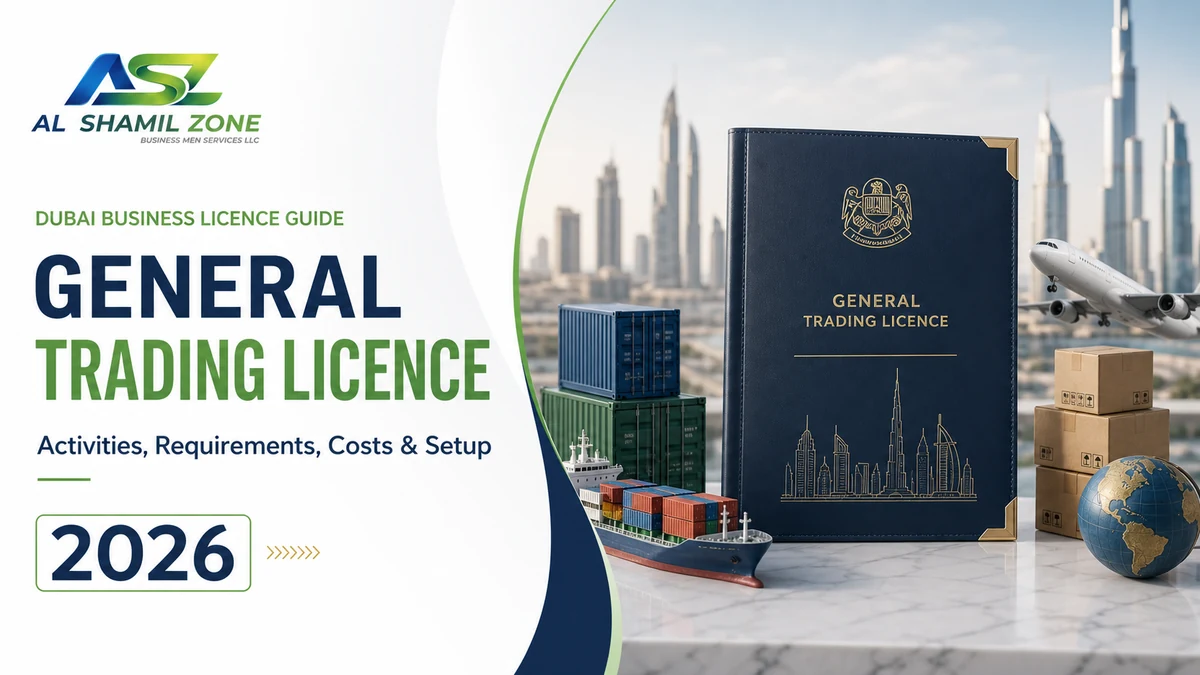
A Dubai general trading licence can support the purchase, sale, import, export, re-export and distribution of a broad range of permitted goods. It is attractive to entrepreneurs who plan to trade across several product categories, but it is not an unrestricted licence for every product.
The correct jurisdiction, activities, customs registrations, premises and external approvals depend on what the company will trade, where goods will enter the UAE, how they will be stored and who the customers will be.
What is a Dubai general trading licence?
A general trading licence is a commercial licence designed for businesses trading multiple groups of permitted goods. Compared with a narrowly defined trading activity, it can offer more flexibility when the business model includes several unrelated product categories.
The licence does not automatically authorise:
- regulated, restricted or prohibited goods;
- products requiring municipality, health, security or industry approvals;
- customs clearance without the required importer or customs registration;
- storage in premises not approved for the goods;
- online sales without satisfying applicable consumer and e-commerce rules; or
- activities that are not included on the issued licence.
What activities can it cover?
Subject to the issuing authority's activity definition and product approvals, a general trading business may deal in categories such as:
- consumer goods and household products;
- office equipment and supplies;
- textiles, garments and accessories;
- electronics and technology products;
- furniture and interior products;
- tools, hardware and selected building materials;
- packaged goods and other approved merchandise; and
- wholesale, import, export, re-export and distribution connected to approved goods.
The wording varies by authority. A founder should prepare an actual product list rather than relying only on the phrase “general trading”. Product composition, intended use, brand rights and country of origin can affect approvals.
Products that commonly need additional approval
Extra registrations or approvals may apply to food, cosmetics, medical products, pharmaceuticals, chemicals, telecommunications equipment, vehicles, tobacco, precious metals, controlled building materials and other regulated goods.
Approval can involve federal or local regulators, product registration, conformity documentation, laboratory testing, Arabic labels, storage controls or specialised premises. Confirm these requirements before ordering stock or signing supply contracts.
Mainland or Free Zone?
| Consideration | Dubai mainland | UAE Free Zone |
|---|---|---|
| Primary market | Well suited to direct UAE mainland trade, subject to activity and product rules | Often suited to international trade, re-export and operations within the chosen zone |
| Premises | Approved commercial premises and Ejari are generally required | Workspace and warehouse packages depend on the Free Zone |
| Mainland distribution | Conducted through the mainland company under its approved activities | Requires the correct customs and commercial arrangement for mainland sales |
| Customs | Register with the relevant customs authority where importing or exporting | Free Zone customs procedures and mainland entry requirements may both apply |
| Visas | Linked to establishment eligibility and premises | Allocation usually depends on the package and workspace |
Read our Mainland vs Free Zone comparison and guide explaining how a Free Zone company can do business on the mainland.
Documents commonly required
- passport copies and photographs of shareholders and managers;
- Emirates ID and current residence details, where applicable;
- proposed trade names;
- initial approval and activity selection;
- memorandum of association or incorporation documents;
- approved tenancy, Ejari or Free Zone workspace agreement;
- ultimate beneficial owner information;
- external approvals for regulated products; and
- legalised corporate documents where a foreign company is a shareholder.
For a wider checklist, see Documents Required to Start a Company in the UAE.
Step-by-step setup process
- Define the product scope. List the goods, brands, source countries, destination markets and storage model.
- Choose the jurisdiction. Compare mainland and Free Zone rules against the real supply chain.
- Select the activities. Confirm whether general trading covers the entire product plan or whether extra activities are needed.
- Reserve the trade name. Submit compliant name options to the licensing authority.
- Obtain initial approval. Secure any product or regulator approvals required before final licensing.
- Prepare the legal documents. Complete the memorandum, ownership and manager appointments.
- Secure suitable premises. Arrange the approved office, warehouse or Free Zone facility.
- Issue the licence. Pay the authority's final voucher and obtain the incorporation documents.
- Complete operational registrations. Arrange customs, tax, immigration, labour, banking and product registrations as applicable.
Dubai Customs business registration
A company that needs to transact with Dubai Customs must complete business registration through the applicable Dubai Trade service. Dubai Customs' customer guidance states that the applicant provides its valid licence, address, activities, facilities and user information. Once registration is completed, Dubai Customs issues a unique Customs Business Code.
The business code is connected to the validity of the trade licence. Renew the licence before requesting renewal of the customs registration. Depending on the supply chain, the company may also need a customs broker, importer records, HS-code classification, certificates of origin and product-specific permits.
Our detailed Dubai Customs Business Code and Import-Export Guide explains this stage further.
How much does a general trading licence cost?
There is no single reliable price for every general trading company. The total can include:
- trade-name reservation and initial approval;
- licence issuance and general-trading activity fees;
- memorandum or corporate-document charges;
- office, flexi-desk, warehouse or showroom costs;
- immigration file and residence visas;
- customs and chamber registrations;
- external approvals and product registrations;
- establishment, insurance and identity-card costs; and
- annual renewals, accounting, tax and compliance expenses.
Compare the complete first-year and recurring annual cost. An advertised entry price may exclude the facility, visas, customs registration, product approvals or immigration charges. Our UAE Business Licence Costs guide explains the main pricing factors.
VAT and Corporate Tax
A trading company should review VAT registration from the beginning because imports and taxable supplies contribute to the threshold analysis. Current Federal Tax Authority guidance states that VAT registration is mandatory for a UAE-resident business when taxable supplies and imports exceed AED 375,000 over the previous 12 months or are expected to exceed that amount in the next 30 days. Voluntary registration may be available above AED 187,500.
The company must also assess UAE Corporate Tax registration, return filing, transfer pricing and record-keeping. Free Zone incorporation does not automatically make every trading income stream eligible for a 0% Corporate Tax rate.
Bank-account preparation
A general trading licence does not guarantee a bank account. Banks commonly request:
- a clear product and supply-chain description;
- supplier and customer information;
- expected countries, currencies and transaction values;
- contracts, invoices, purchase orders or letters of intent;
- source-of-funds and shareholder records; and
- evidence of premises and commercial substance.
Read How to Open a Business Bank Account in the UAE before preparing the application.
Common setup mistakes
- assuming general trading includes every regulated product;
- selecting a low-cost jurisdiction that does not fit the actual customer market;
- ordering goods before confirming product and customs approvals;
- using incorrect HS codes or incomplete origin documentation;
- failing to budget for warehousing, logistics and customs deposits;
- mixing personal and company transactions; and
- ignoring VAT, Corporate Tax, bookkeeping and UBO obligations.
Official references
- UAE Government: Steps to start a mainland business
- Dubai Customs: Customer Guide
- Federal Tax Authority: VAT registration
Plan your Dubai trading company
Al Shamil Zone can compare mainland and Free Zone options, confirm suitable activities, prepare the licensing documents and coordinate customs, visa and operational registrations.
Discuss your trading plan: call +971 4 408 1900, message +971 50 777 5554 on WhatsApp, or request a consultation.
This article provides general information, not legal, customs, tax, product-regulatory or investment advice. Activities, fees, product approvals and customs requirements depend on the actual business and current authority rules.
Ready to get started? Contact Al Shamil Zone by phone at 800 2794, via WhatsApp at +971 54 586 6222, or email info@shamilservices.ae.