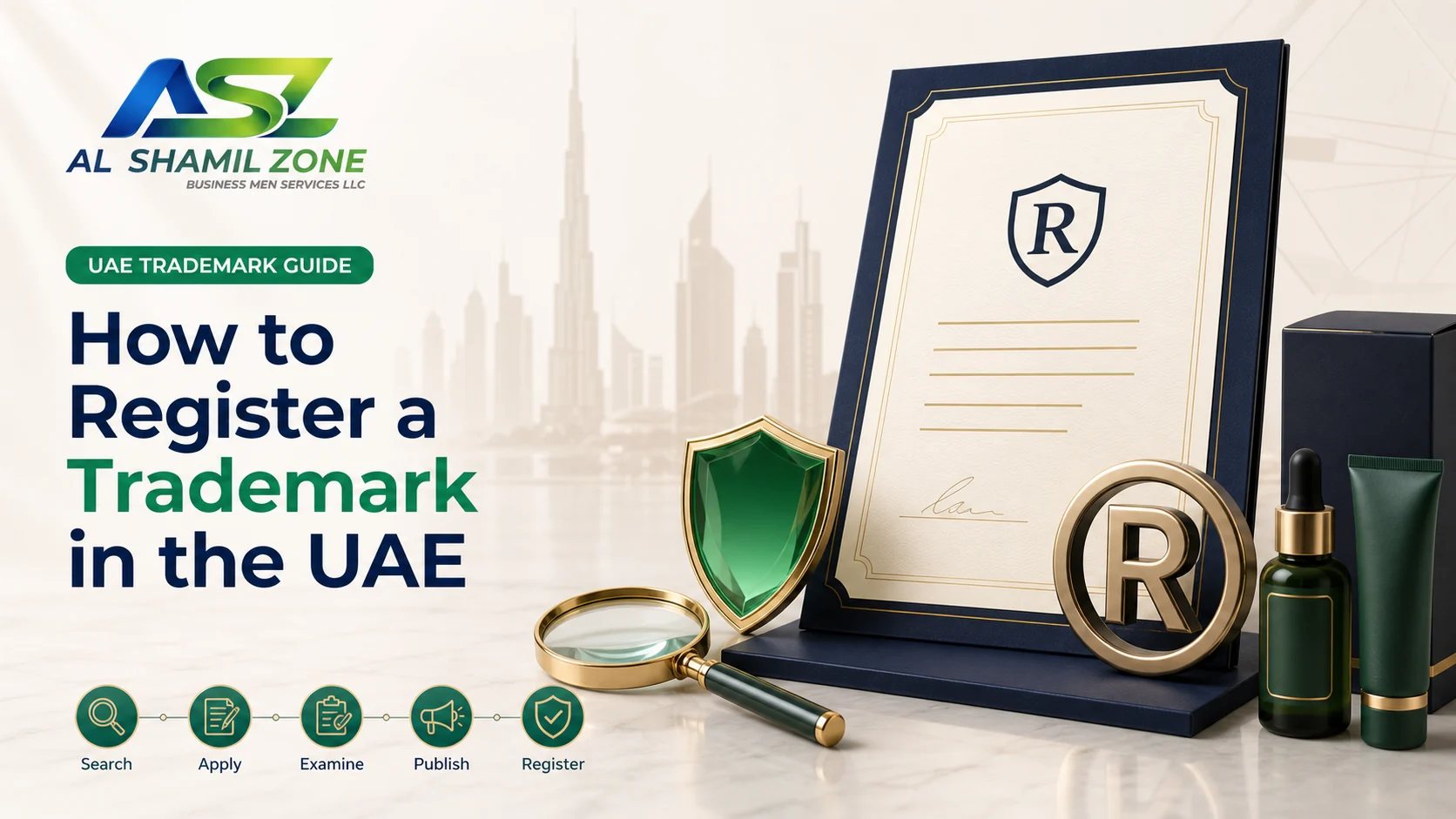
How to Register a Trademark in the UAE
A practical guide to UAE trademark searches, classes, application fees, examination, publication, objections, registration and renewal.
Registering a trade name or receiving a business licence does not automatically give a company registered trademark protection. A trademark is a separate intellectual-property right used to distinguish the goods or services of one business from those of others.
For a growing UAE business, early registration can make it easier to protect the brand, expand into new products, appoint distributors, license the mark and respond to confusingly similar applications. The process should begin before significant money is committed to signage, packaging, advertising or domain names.
Trademark, trade name and company name: what is the difference?
These terms are often confused:
- Trade name: the commercial name reserved with the relevant licensing authority for a business licence.
- Company name: the legal name appearing on incorporation documents and contracts.
- Trademark: a sign registered to identify and distinguish specified goods or services.
- Domain name: an internet address registered through a domain registrar.
The same wording may appear in all four, but each is governed through a different registration system. Approval of one does not guarantee approval or ownership of the others.
What can be protected as a trademark?
Depending on the legal requirements, a trademark can include words, names, letters, numbers, logos, drawings, symbols, packaging elements, combinations of colours, three-dimensional forms or other signs capable of distinguishing goods or services.
Some marks are difficult or impossible to register. Problems can arise when a mark is:
- descriptive of the goods or services;
- generic or commonly used in the trade;
- confusingly similar to an earlier mark;
- misleading about origin, quality or characteristics;
- contrary to public order or accepted standards;
- based on protected official symbols or emblems; or
- filed without the required consent or authority.
A creative logo does not necessarily solve a weak word mark. Businesses should consider whether they need protection for the brand name, the logo or both.
Step 1: Decide who should own the trademark
The applicant can be an eligible individual, company or institution. Ownership should be decided before filing because later transfers involve separate procedures and documentation.
Questions to resolve include:
- Will the UAE operating company own the brand?
- Should a holding or intellectual-property company own it and license its use?
- Was the logo created by an employee, founder or external designer?
- Does the applicant have written rights to all artwork and brand elements?
- Will investors, franchisees or distributors require a particular ownership structure?
If an application is filed in the wrong person's name, fixing the ownership later may add cost and complexity.
Step 2: Conduct a trademark search
A clearance search reduces the risk of applying for a mark that conflicts with an earlier registration or application. It should assess identical and similar marks, not only exact spelling.
The Ministry provides a paid Trademark Inquiry service. At the position date of this guide, the service card lists an AED 350 government fee and describes the result as immediate. A search result is useful, but it is not a guarantee that the application will be accepted or remain unopposed.
A stronger clearance exercise can also consider:
- alternative spellings and phonetic similarities;
- Arabic and English versions or transliterations;
- similar logos and visual concepts;
- related goods and services;
- trade names, domains and marketplace use; and
- the applicant's intended expansion plans.
Step 3: Select the correct goods, services and classes
Trademark protection is connected to the goods and services stated in the application. They are organised under an international classification system.
Choosing a class based only on the company's trade-licence wording can lead to gaps. A technology business, for example, may need to distinguish between downloadable software, software-as-a-service, technical consultancy, retail services and telecommunications.
Before filing, map:
- what the business sells today;
- what it realistically plans to sell during the next few years;
- which goods are manufactured and which are only traded;
- whether services are delivered directly, online or through licensees; and
- whether separate applications or fees are required for additional classes.
Overly narrow wording can leave important products unprotected. Overly broad or inaccurate wording may create examination or commercial problems.
Step 4: Prepare the mark and application documents
Common requirements can include:
- the applicant's identification or company details;
- a commercial licence when filing in the name of a UAE company or institution;
- a clear representation of the trademark;
- the list and class of goods or services;
- a translation or explanation of non-Arabic wording where requested;
- a priority document when claiming convention priority; and
- a legal power of attorney when filing through a registered trademark agent.
The Ministry's current service information states that an owner outside the UAE must submit through a registered agent and attach the required legalised and notarised power of attorney.
Step 5: Submit the application and pay the filing fee
The application is submitted electronically through the Ministry service. It should be checked carefully before payment because errors in the owner, mark or class can affect the scope and validity of the application.
At the position date, the Ministry service card lists the following registration-stage government fees:
| Stage | Government fee listed by the Ministry |
|---|---|
| Application | AED 750 |
| Publication in the official bulletin | AED 750 |
| Final registration | AED 5,000 |
| Total registration-stage fees | AED 6,500 |
The optional inquiry fee, additional-class applications, translation, legalisation, agent charges, objection proceedings and other services are separate. Always confirm the current portal charges before budgeting.
Step 6: Ministry examination
The Ministry examines whether the application meets the legal and procedural requirements and whether the mark can proceed. It may accept the application, raise a query, request a change or refuse it.
Applicants should monitor the registered email address and portal. Missing a deadline to respond or pay a stage fee can delay or prejudice the application.
The Ministry service card provides an indicative service-delivery period, but this should not be treated as a guaranteed end-to-end registration timeline. Queries, amendments and objections can extend the process.
Step 7: Publication and the objection period
After acceptance and payment of the publication fee, the mark is published in the Official Trademark Bulletin. This allows third parties to review the application.
The current executive regulations provide a 30-day objection period from publication. If an objection is filed, the applicant must respond within the applicable deadline and the matter follows a separate procedure.
Businesses should not assume that initial acceptance means the registration is final. Publication is an important stage where owners of earlier rights can challenge the mark.
Step 8: Pay the final registration fee
If the objection period ends without a blocking objection, or an objection is resolved in the applicant's favour, the final registration fee must be paid within the prescribed period. The Ministry then issues the trademark registration certificate.
Store the certificate, application record, artwork, classification wording and payment receipts securely. Banks, marketplaces, customs authorities, investors, licensees and enforcement advisers may request them later.
How long is UAE trademark protection valid?
Trademark protection is generally granted for a ten-year period and can be renewed for further ten-year periods, subject to the applicable law and renewal procedure.
The Ministry currently provides a renewal service during the final year of protection and a limited post-expiry renewal period with increased fees. Do not wait for expiry: place the renewal date in the company's compliance calendar and keep the owner details current.
What rights does registration provide?
Registration can support the owner's exclusive rights in relation to the registered mark and covered goods or services. It can also strengthen:
- oppositions against confusingly similar applications;
- marketplace and domain-name complaints;
- licensing, franchising and distribution arrangements;
- customs or enforcement actions where available;
- brand valuation and investment due diligence; and
- international expansion applications.
Registration does not remove the need to monitor the market. The Ministry will not automatically identify every infringement on behalf of the owner.
Can a UAE trademark be extended internationally?
Trademark rights are territorial. A UAE registration does not automatically protect the mark in Saudi Arabia, the wider GCC or the rest of the world.
Eligible UAE applicants can use the Madrid Protocol system to request protection in selected member jurisdictions through a central filing route. The Ministry's current service requires a UAE trademark application or registration as the base. International fees and examination are determined separately for the selected jurisdictions.
Common trademark-registration mistakes
- Assuming the trade name already protects the brand.
- Launching publicly before conducting a proper search.
- Filing in a founder's name when the company should own the mark.
- Protecting only a logo when the business also needs the word mark.
- Selecting the wrong class or incomplete goods and services.
- Ignoring Arabic spellings or transliterations used in the market.
- Missing a Ministry query, publication payment or objection deadline.
- Failing to secure written rights from the logo designer.
- Believing a UAE registration provides worldwide protection.
- Forgetting to renew or update ownership details.
UAE trademark application checklist
- Confirm the correct legal owner.
- Check ownership of the artwork and brand assets.
- Search identical and similar marks.
- Review English, Arabic and phonetic variants.
- Select the required goods, services and classes.
- Prepare a clean representation of the mark.
- Collect the licence, identification and power-of-attorney documents.
- Submit and monitor the Ministry application.
- Pay publication and registration fees within their deadlines.
- Record the registration, monitoring and renewal dates.
Official references
- Ministry of Economy and Tourism: Trademark Registration
- Ministry of Economy and Tourism: Trademark Inquiry
- Ministry of Economy and Tourism: Trademark Renewal
- Ministry of Economy and Tourism: Madrid Protocol service
Need support protecting your UAE brand? Call Al Shamil Zone on 800 2794, contact us through WhatsApp, or email info@shamilservices.ae.
This article provides general information and is not intellectual-property or legal advice. Registrability, classification and enforcement depend on the mark, owner, goods or services, earlier rights and current law. Obtain professional advice for your application and disputes.
Ready to get started? Contact Al Shamil Zone by phone at 800 2794, via WhatsApp at +971 54 586 6222, or email info@shamilservices.ae.