How to Add or Remove a Partner from a UAE Company
A practical guide to UAE company share transfers, partner additions and exits, required documents, UBO records, tax updates, banking and visas.
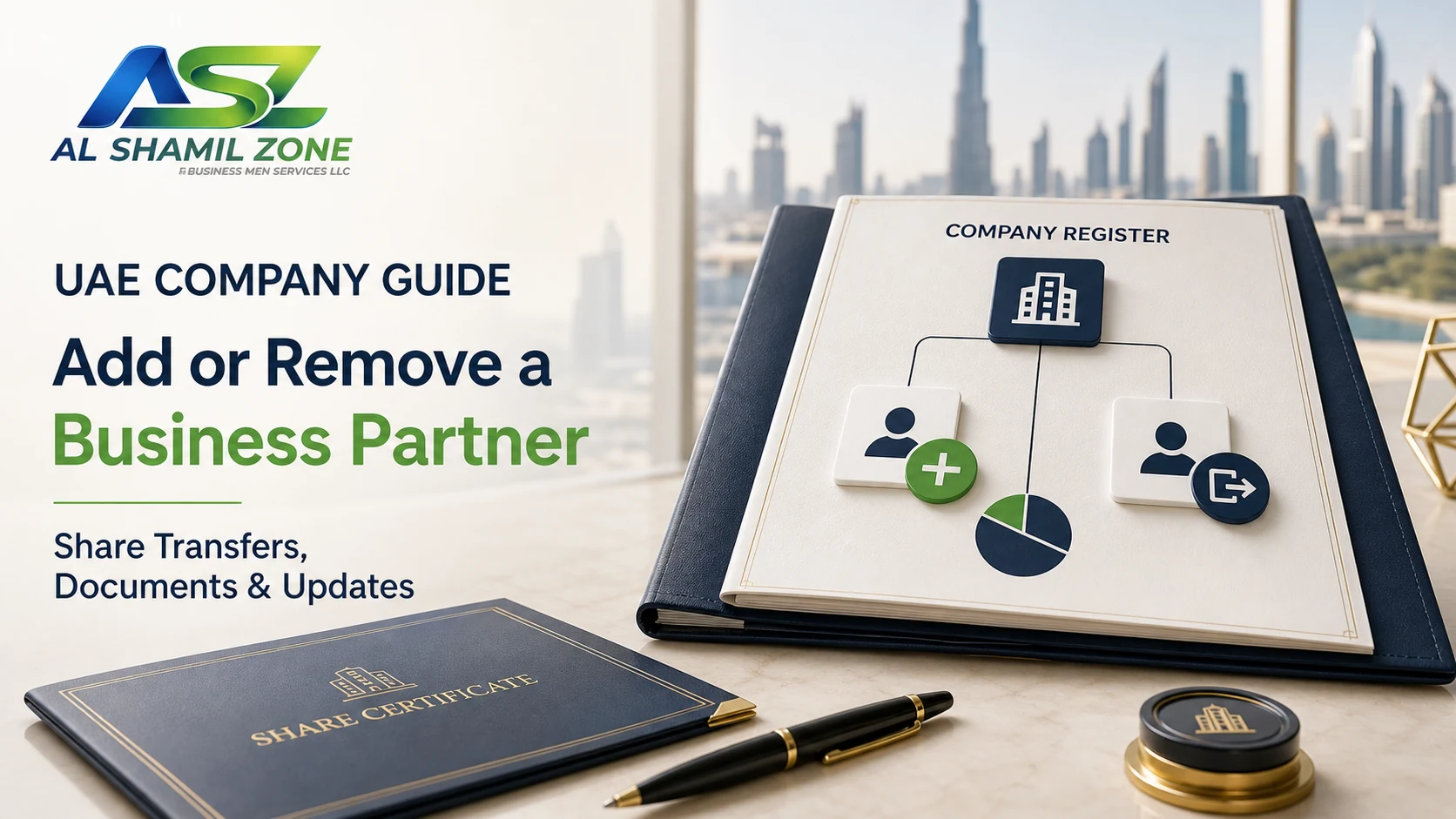
Adding or removing a partner from a UAE company is an ownership transaction, not merely a name change on the trade licence. The parties must determine what happens to the shares, approve and document the transaction, amend the constitutional documents, register the new ownership with the licensing authority and update every connected record.
The correct process depends on the company's legal form, emirate, free zone, regulated activity, memorandum of association and the identity of the incoming or outgoing owner.
Ownership changes at a glance
| Objective | Typical legal route |
|---|---|
| Add a new partner using existing shares | One or more existing partners transfer part of their shares |
| Add a new partner with new capital | The company increases capital and issues or allocates new shares where permitted |
| Remove a partner | The outgoing partner transfers shares to another partner, a new investor or through another permitted company-law mechanism |
| Change ownership percentages | Partners transfer shares or restructure the capital allocation |
| Replace a corporate shareholder | Share transfer supported by corporate approvals and ownership documents |
| Change only the manager | Management amendment, not necessarily an ownership transfer |
First determine what is actually changing
“Partner” is sometimes used loosely to mean shareholder, manager, local service agent, authorised signatory or commercial collaborator. These roles are different.
Before beginning, answer:
- Who legally owns the shares today?
- How many shares and voting rights does each person hold?
- Who will own them after the transaction?
- Is new money entering the company?
- Will the manager, authorised signatory or board also change?
- Will the beneficial owner change?
- Does the company have nominee, trust or family-business arrangements?
- Are any shares pledged, frozen or subject to a dispute?
A manager can leave while remaining a shareholder. A shareholder can sell shares while remaining the manager. Each change needs its own approvals and filings.
Review the company's legal documents
Read the current memorandum and articles, shareholder agreement, side agreements and company register before agreeing commercial terms. They may contain:
- pre-emption or first-refusal rights;
- minimum ownership requirements;
- approval thresholds;
- restrictions on transfers to competitors or outsiders;
- tag-along or drag-along rights;
- valuation mechanisms;
- deadlock provisions;
- pledges or security over shares;
- rules following death or incapacity; and
- requirements for notarisation or authority consent.
A private agreement between buyer and seller does not by itself make the buyer the registered partner. The transfer must satisfy the company's documents and be registered with the competent authority.
Route 1: Transfer existing shares to a new partner
This is the usual route when an incoming investor buys part of an existing owner's interest. The purchase price is generally paid to the selling shareholder, while the company's capital may remain unchanged.
The transaction commonly involves:
- commercial agreement on shares, price and conditions;
- due diligence on the company and incoming partner;
- required offers or waivers under pre-emption provisions;
- shareholder or board resolutions;
- a share-transfer agreement or authority form;
- amended memorandum or constitutional document;
- licensing-authority application and identity checks;
- notarisation, electronic signing or attestation where required; and
- issuance of updated company documents and licence.
Do not release the full purchase price solely against a signed private agreement if completion also depends on regulatory approval. Use clear completion conditions and a safe payment arrangement.
Route 2: Add a partner by increasing capital
Where the company needs funding, it may be more appropriate to increase its share capital and allocate the new interest to the incoming partner. In that structure, money normally enters the company rather than being paid only to an existing shareholder.
Confirm:
- whether the legal form and authority permit the proposed increase;
- the new total capital and number or value of shares;
- whether existing partners have priority rights;
- how the company is valued;
- whether a share premium is used;
- the evidence required for capital contribution; and
- accounting and Corporate Tax treatment.
A valuation of AED 5 million does not necessarily mean the registered share capital should become AED 5 million. Enterprise value, purchase price, share capital and share premium are different concepts.
How an outgoing partner is removed
An owner's shares cannot normally disappear. They must move to another person or be dealt with under a permitted capital-reduction, redemption, inheritance, court or company-law mechanism.
A voluntary exit commonly involves:
- agreeing who acquires the outgoing interest;
- settling the valuation and payment terms;
- checking pre-emption and consent requirements;
- resolving shareholder loans, dividends and current accounts;
- transferring the shares;
- amending the memorandum and registers;
- removing management or signatory powers separately where applicable; and
- updating all authority and third-party records.
Resignation as manager, cancellation of a residence visa or handing back an office key does not remove share ownership.
Can the remaining owner hold 100%?
Most UAE mainland commercial activities now allow 100% foreign ownership. However, strategic-impact and restricted activities can have special ownership and approval requirements.
Also confirm whether the company's legal form supports a single shareholder. An LLC may need to be recorded as a one-person company or its constitutional description may need adjustment. Free zones apply their own company regulations and naming conventions.
Mainland company process
For a mainland company, the competent emirate's economic department or licensing authority registers the ownership change. A typical file may include:
- current trade licence and commercial registration;
- current memorandum of association;
- passport, Emirates ID and visa information for natural-person parties;
- corporate documents for a legal-person shareholder;
- shareholder and board resolutions;
- share-transfer instrument;
- amended memorandum;
- beneficial-owner declarations;
- external regulator approval for a controlled activity;
- establishment or immigration documents where linked changes are requested; and
- authority forms and payment of fees.
Document signing may occur electronically, before a notary or through another approved channel. Requirements vary by emirate, legal form and nationality.
Free-zone company process
Each free zone maintains its own company register and amendment service. For example, DMCC provides a company-amendment route for share transfers through its Member Portal.
A free-zone authority may request:
- portal application;
- shareholder resolution;
- share-transfer agreement or authority template;
- passport, address and know-your-customer documents;
- source-of-funds or business-profile information;
- amended articles or company register;
- corporate documents for institutional shareholders;
- UBO declaration; and
- payment and physical or video identity verification.
Do not submit mainland forms to a free zone or assume that two free zones use the same process.
When the incoming partner is a company
A corporate shareholder generally requires a fuller document chain, which may include:
- certificate of incorporation and valid commercial extract;
- memorandum and articles;
- register of directors and shareholders;
- board or shareholder resolution approving the investment;
- power of attorney for the signatory;
- ownership chart identifying the ultimate natural persons;
- passport and address evidence for beneficial owners; and
- legalisation, attestation and certified translation for foreign documents.
Check document age and legalisation requirements before arranging signatures abroad.
Due diligence before adding a partner
The incoming investor should review the company rather than relying only on the licence. The existing partners should also verify the investor.
Company due diligence should cover:
- licence, activities and renewals;
- constitutional documents and ownership;
- financial statements, debts and shareholder accounts;
- VAT and Corporate Tax registrations and filings;
- employees, gratuity and labour claims;
- leases and major contracts;
- litigation, guarantees and security;
- intellectual property and data;
- regulatory approvals; and
- UBO and anti-money-laundering compliance.
The company should verify the incoming owner's identity, source of funds, sanctions exposure, business background and approval eligibility.
Agree the commercial terms in writing
A share-transfer agreement should address:
- the exact shares transferred;
- purchase price, currency and payment timing;
- conditions before completion;
- authority rejection or delay;
- business conduct before completion;
- warranties and disclosure;
- treatment of debt, cash and shareholder loans;
- taxes, fees and professional costs;
- handover of records and access;
- confidentiality and restrictive covenants;
- liability limitations; and
- governing law and dispute resolution.
Legal registration and commercial completion should be coordinated so neither party is left without shares or payment protection.
Update the beneficial-owner records
Cabinet Decision No. 109 of 2023 requires a legal person to maintain a beneficial-owner register and update changes within 15 days from becoming aware of them. The partners or shareholders register must also remain current.
The company may not register or give effect to an ownership-change document unless the transferee provides a statement explaining whether the transfer changes the company's beneficial owner and, if so, the nature and details of that change.
Beneficial ownership is not always identical to the name on the licence. The assessment looks through ownership chains and other control to the relevant natural person or persons.
Update the Federal Tax Authority
The FTA's current Tax Records Amendment service states that registered persons must submit the required amendment within 20 business days from a change in registered information or circumstances.
After an ownership transaction, review:
- taxable-person and owner details;
- authorised signatories;
- trade licence and legal name;
- address and business activities;
- bank account information;
- VAT group or Corporate Tax group membership;
- customs registration; and
- whether the transaction changes the taxable person rather than only its owners.
An LLC that retains the same legal identity and TRN is different from transferring the whole business to a newly formed company. Confirm the tax treatment before completion.
Banking and finance updates
Banks conduct their own know-your-customer review. Provide the updated licence, memorandum, share register, UBO declaration, resolutions, identity documents and ownership chart promptly.
Also update:
- authorised signatories and online banking users;
- cards and transaction limits;
- loan covenants and change-of-control notices;
- merchant accounts and payment gateways;
- trade-finance facilities; and
- personal or corporate guarantees.
A partner's exit from the licence does not automatically release a personal guarantee. Obtain written confirmation from the creditor.
Immigration, labour and establishment records
If the outgoing partner holds an investor or partner residence, assess whether it must be cancelled or changed. If that person is also the establishment signatory, manager or employee, update the relevant immigration and MoHRE records separately.
For an incoming partner, ownership registration and residence eligibility are related but distinct procedures. Do not promise a particular visa until the authority confirms the company, ownership, medical, identity and immigration requirements.
Contracts, leases and regulatory approvals
Review agreements for change-of-control, consent or notification clauses. Important examples include:
- office lease and free-zone facility agreement;
- bank and finance documents;
- franchise or distribution agreement;
- government or major-customer contract;
- insurance policy;
- professional regulator approval; and
- intellectual-property licence.
A valid licence amendment can still put the company in breach of a private contract if required consent was not obtained.
Common mistakes
- Treating removal of a partner as deletion rather than a share transaction.
- Ignoring pre-emption rights in the memorandum or shareholder agreement.
- Paying the full price before authority approval.
- Using an informal valuation without addressing debt or shareholder loans.
- Failing to legalise foreign corporate documents.
- Assuming 100% foreign ownership applies to every activity.
- Changing the manager but not the shareholder, or vice versa.
- Leaving UBO and shareholder registers outdated.
- Missing the FTA amendment timeline.
- Forgetting bank signatories and personal guarantees.
- Leaving the outgoing partner's portal and email access active.
- Ignoring visas, contracts and regulator consents.
Ownership-change checklist
- Confirm the current legal and beneficial ownership.
- Define the intended post-transaction structure.
- Review the memorandum and shareholder agreement.
- Check activity and nationality restrictions.
- Complete buyer, seller and company due diligence.
- Agree valuation, price and funding route.
- Obtain pre-emption waivers and corporate approvals.
- Prepare the transfer and amended constitutional documents.
- Obtain regulator or third-party consent where required.
- Register the change with the licensing authority.
- Issue the updated licence and company register.
- Update UBO records within the applicable timeline.
- Update FTA records, banking, customs and insurance.
- Update immigration, labour and signatory records.
- Complete payment and secure the closing file.
- Remove obsolete access and complete the handover.
Official references
- UAE Government: Full foreign ownership of commercial companies
- Cabinet Decision No. 109 of 2023: Beneficial-owner procedures
- Federal Tax Authority: Tax Records Amendment
- DMCC: Share Transfer Guidelines
- DMCC: Managing a company and company amendments
Need help coordinating a UAE company ownership amendment? Call Al Shamil Zone on 800 2794, contact us through WhatsApp, or email info@shamilservices.ae.
This article provides general information and is not legal, tax or investment advice. Requirements depend on the authority, legal form, activity, documents and parties. Obtain current authority confirmation and professional advice before transferring shares.
Ready to get started? Contact Al Shamil Zone by phone at 800 2794, via WhatsApp at +971 54 586 6222, or email info@shamilservices.ae.