How to Hire Your First Employee in the UAE
A practical guide to establishment registration, job offers, work permits, medical fitness, Emirates ID, residence, health insurance and WPS payroll.
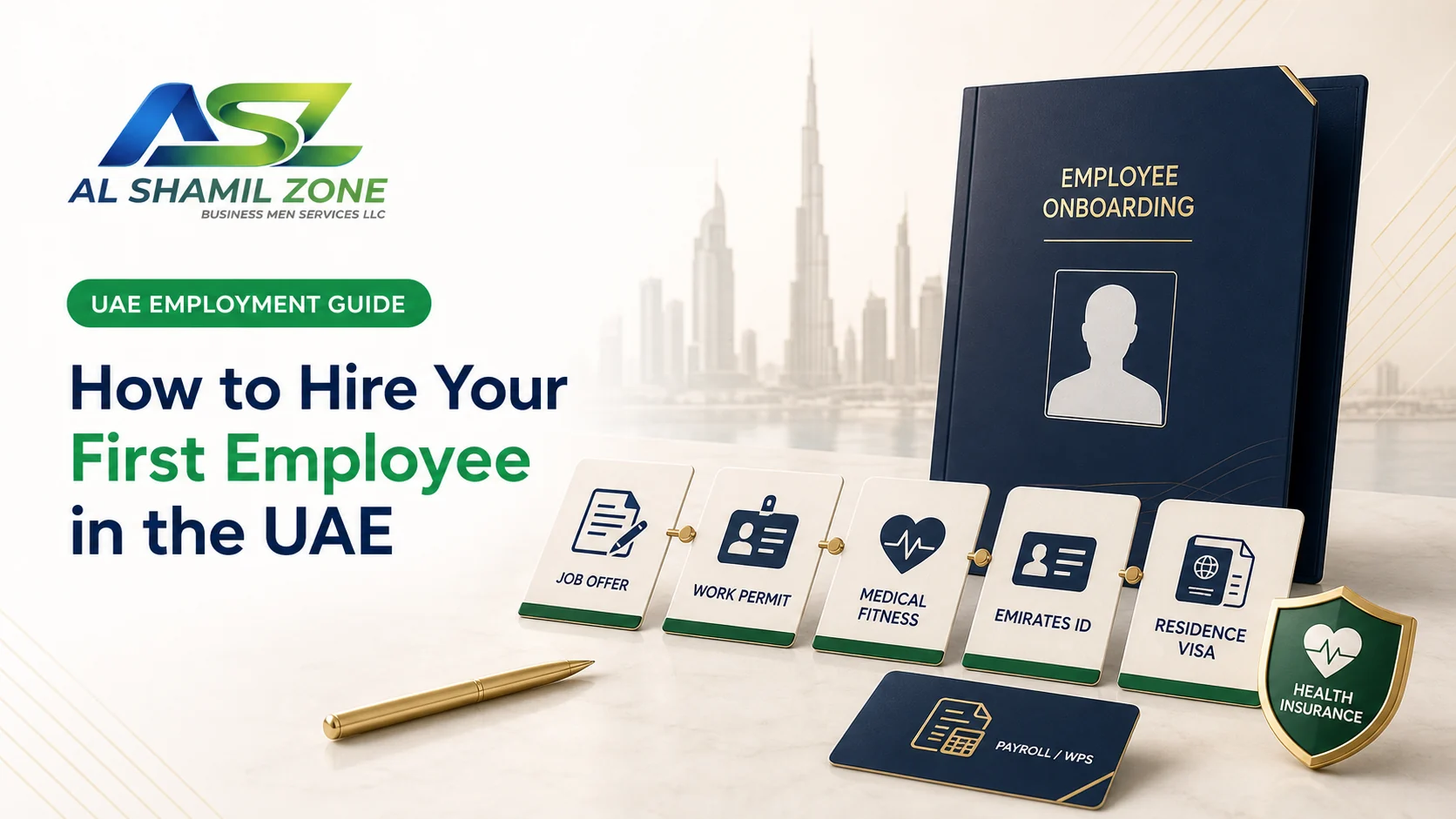
Hiring your first employee in the UAE is more than finding the right candidate. Before that person can legally work, the company must have the appropriate employer registration, obtain the correct work authorisation and complete the connected residency, identity, insurance and payroll steps.
The exact route depends on whether the company is licensed on the Mainland or in a Free Zone, whether the employee is inside or outside the UAE, the type of work permit and the rules of the relevant authority.
The first decision: Mainland or Free Zone employer?
Mainland private-sector establishments generally deal with the Ministry of Human Resources and Emiratisation (MoHRE) for establishment and employment procedures, alongside the relevant immigration and identity authorities.
Free Zone companies normally process employee permits and residence procedures through their respective Free Zone authority. Many Free Zones provide an integrated portal, but their packages, visa allocations, office requirements and document lists differ.
ADGM and DIFC also operate within distinct legal and regulatory frameworks. Employers in specialised jurisdictions should verify which employment rules apply rather than assuming that every Free Zone follows the same process.
Step 1: Make sure the company can sponsor an employee
A new company should confirm its employer file and visa eligibility before making an unconditional promise to a candidate.
For a Mainland company, this commonly involves opening an establishment file and obtaining an establishment card and number linked to the trade licence. The official UAE Government guidance describes this registration as the step that enables the establishment to operate and recruit employees.
For a Free Zone company, check:
- whether the licence package includes visa eligibility;
- how many visas the office or facility permits;
- whether an establishment or immigration card is active;
- whether the trade licence and lease are valid; and
- whether the selected job title is consistent with the business activity and candidate's qualifications.
Step 2: Budget for the full employment cost
The employee's salary is only one part of the cost. A realistic first-year budget may need to include:
- work-permit and immigration charges;
- status adjustment or entry-permit costs;
- medical fitness testing;
- Emirates ID and residence processing;
- mandatory health insurance;
- recruitment or relocation expenses;
- payroll and Wage Protection System arrangements;
- paid leave and statutory employment entitlements;
- end-of-service obligations where applicable; and
- renewal and cancellation costs.
Government fees vary according to authority, permit category, employee profile, duration, establishment classification and whether the candidate is already in the UAE. Obtain a case-specific estimate rather than publishing one fixed “visa price” in the employment offer.
Step 3: Choose the correct work-permit route
It is unlawful for a person to work without the required work permit. The UAE provides several permit categories, including standard employment, part-time, temporary, one-mission, juvenile, student-training, UAE or GCC national, Golden Visa holder and freelance permits, subject to their individual rules.
A residence status does not necessarily give permission to work for a particular company. For example, an individual sponsored by family or holding a Golden Residency may still require the appropriate work permit for the employment arrangement.
Before applying, verify:
- where the candidate is currently located;
- their current visa and work-permit status;
- whether an existing permit must be cancelled;
- whether the proposed role needs an academic or professional qualification;
- whether documents require attestation; and
- whether the role requires approval from another regulator.
Step 4: Issue the official job offer and employment contract
The commercial discussion should be converted into the authority-approved job offer and employment contract. The documents should accurately state the role, salary components, work location, working pattern, benefits, leave, probation and notice terms.
Do not use a side letter to contradict the official contract. Inconsistencies between the signed offer, authority contract, payroll transfer and internal HR records can create disputes and compliance issues.
Probation may be used subject to UAE Labour Law requirements and cannot exceed the legal maximum. Notice requirements during probation depend on whether the employee is leaving the UAE, joining another UAE employer or being terminated, so obtain advice for the actual situation.
Step 5: Obtain the work permit and entry or status approval
Once the employment documents and supporting file are accepted, the employer proceeds with the relevant work-authorisation and immigration steps.
If the employee is outside the UAE, an entry permit or equivalent authorisation may be required. If the employee is already in the country, an in-country status adjustment may be available, depending on the current visa and authority procedures.
The UAE's Work Bundle is designed to integrate several Mainland employment and residency procedures through one application and unified payment channel. Official guidance says it can cover work permits, residence procedures, Emirates ID, medical fitness and employment contracts.
Step 6: Complete medical fitness, Emirates ID and residence
After the applicable entry or status stage, the employee generally completes:
- medical fitness testing at an approved centre;
- the Emirates ID application and biometrics when required;
- health-insurance enrolment; and
- residence permit issuance or completion.
Names, passport details, job information and personal data must be consistent across every application. Small discrepancies can delay later stages.
Step 7: Arrange mandatory health insurance
Health-insurance requirements should be planned before the residence application reaches its final stage. Dubai and Abu Dhabi have long-standing mandatory systems, and from 1 January 2025 health insurance became a prerequisite for issuing or renewing residence permits for private-sector employees and domestic workers across the other emirates under the applicable scheme.
Coverage, premiums, networks and dependent obligations differ by emirate and employee circumstances. Employers should use an approved insurer and retain the policy evidence in the employee file.
Step 8: Set up compliant payroll and WPS
Mainland private-sector employers generally pay wages through the Wage Protection System (WPS). MoHRE describes WPS as the electronic system used to transfer the salary agreed in the employment contract through approved banks, financial institutions and exchange houses.
Before the first salary is due:
- choose a bank or approved WPS payroll provider;
- register the establishment and employee correctly;
- ensure the salary components match the official contract;
- set a reliable monthly payroll date;
- retain salary information files and transfer confirmations; and
- create an escalation process for rejected or delayed payments.
Free Zone employers should confirm whether WPS applies through their authority or whether another approved salary-payment system is used. A Free Zone label should not be treated as an automatic exemption.
Documents commonly required
| Company documents | Employee documents |
|---|---|
| Valid trade licence | Passport copy with sufficient validity |
| Establishment or immigration card | Recent compliant photograph |
| Office lease or facility details | Current UAE visa or entry-status copy, if applicable |
| Authorised signatory identification | Attested educational certificate where required |
| Authority portal credentials or application forms | Previous permit cancellation or no-objection documents, if required |
| Job offer and approved employment contract | Medical, Emirates ID and insurance documents as the process advances |
The authority may request additional documents based on nationality, profession, current status, business activity or regulated occupation.
How long does hiring take?
There is no reliable universal timeline. A straightforward file may progress quickly, but the process can take longer when:
- the establishment card or licence needs renewal;
- visa allocation or office capacity is insufficient;
- the candidate's current visa must be cancelled;
- qualifications require attestation or verification;
- medical or biometric appointments are delayed;
- names or document details do not match; or
- an external regulator must approve the role.
The Work Bundle has reduced steps for eligible Mainland cases, but employers should still allow contingency time and avoid fixing a start date before work authorisation is confirmed.
Common first-hire mistakes
- Allowing the employee to start work before the permit is issued.
- Promising a visa without checking allocation or establishment eligibility.
- Using a job title that does not match the actual role or qualifications.
- Ignoring health insurance until the residence application is blocked.
- Paying salary outside the required payroll system.
- Keeping different salary figures in the offer, contract and payroll records.
- Failing to retain signed documents and authority approvals.
- Forgetting renewal, cancellation and end-of-service responsibilities.
First-employee onboarding checklist
- Confirm licence validity, establishment registration and visa eligibility.
- Prepare a complete employment budget.
- Select the correct work-permit category.
- Verify the candidate's passport, visa and qualification documents.
- Issue consistent job-offer and employment-contract terms.
- Obtain work authorisation before employment starts.
- Complete medical, Emirates ID, insurance and residence steps.
- Register payroll and WPS or the authority-approved alternative.
- Create a secure employee file and compliance calendar.
- Track probation, leave, salary, renewal and cancellation obligations.
Official references
- UAE Government: Recruiting on the Mainland and Work Bundle
- UAE Government: Work-permit categories
- MoHRE: Wage Protection System
- UAE Government: Health-insurance requirements
Preparing to hire your first employee? Call Al Shamil Zone on 800 2794, contact us through WhatsApp, or email info@shamilservices.ae.
This article provides general information and is not legal, immigration, insurance or employment advice. Requirements depend on the jurisdiction, authority, permit type, profession and employee's circumstances. Confirm the applicable process before hiring or allowing work to begin.
Ready to get started? Contact Al Shamil Zone by phone at 800 2794, via WhatsApp at +971 54 586 6222, or email info@shamilservices.ae.