UAE Family Business Governance and Succession: 2026 Guide
A practical UAE family-business guide covering registry status, family charters, ownership, governance, share transfers, valuation, leadership and succession.
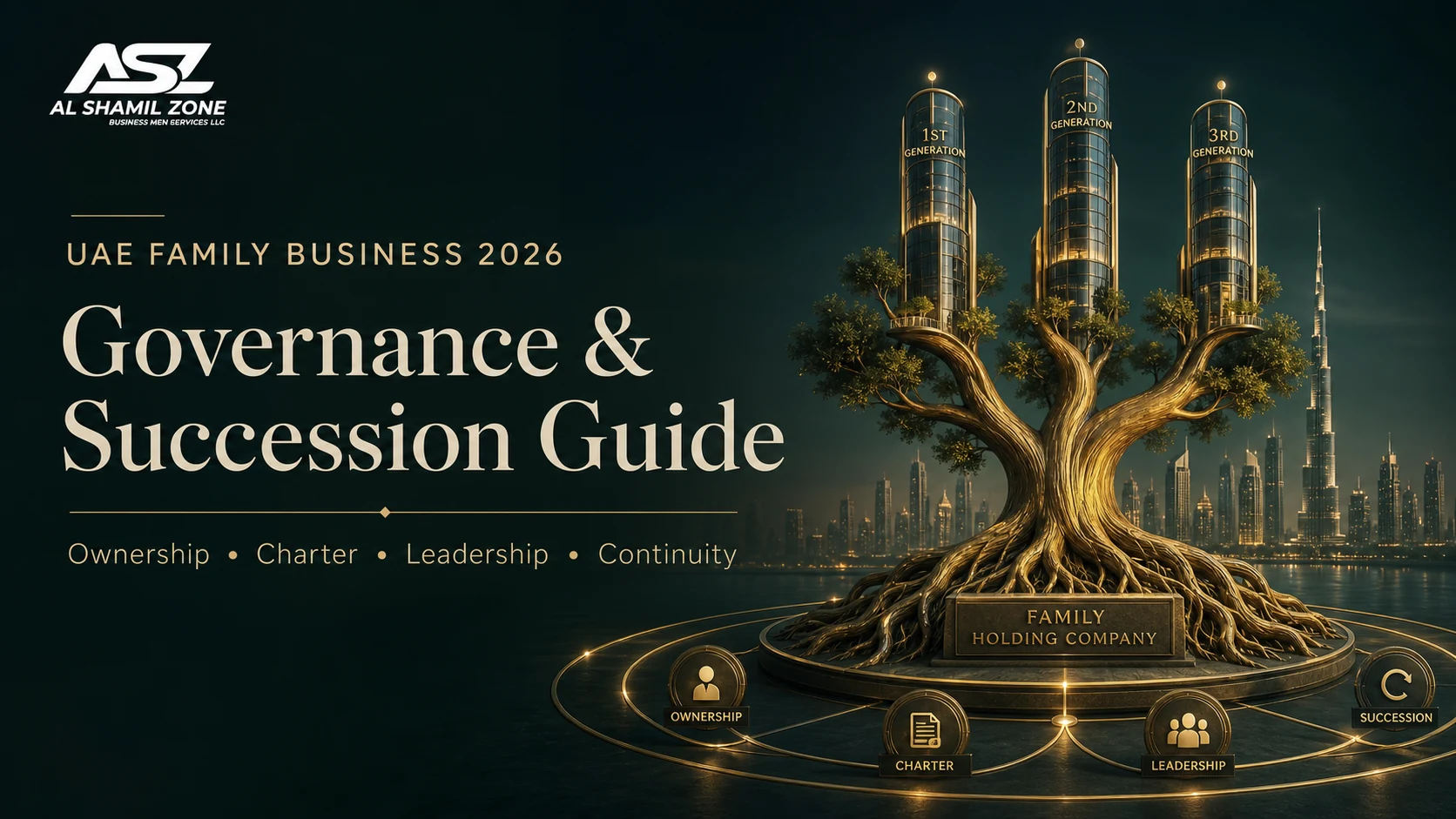
Family businesses often begin with trust, speed and a founder's direct control. As ownership expands across generations, those strengths can become vulnerable if the company has no agreed rules for leadership, employment, dividends, share transfers, valuation or dispute resolution.
Federal Decree-Law No. 37 of 2022 concerning Family Businesses provides a UAE framework through which eligible family-owned companies can organise ownership and governance and support continuity across generations. The Unified Family Business Registry and related ministerial decisions put practical mechanisms around registration, family charters, share classes and company purchases of family shares.
Family-business planning at a glance
| Area | Question the family should answer |
|---|---|
| Ownership | Who may own shares, and what happens when a member wants to sell? |
| Leadership | How are directors and executives selected, assessed and replaced? |
| Succession | How will authority transfer if a founder retires, loses capacity or dies? |
| Family employment | What qualifications and performance standards apply to family members? |
| Economic rights | How are dividends, reinvestment and different share rights decided? |
| Liquidity | How can a shareholder exit without destabilising the company? |
| Disputes | Which internal and formal mechanisms apply before conflict escalates? |
| Governance | Which matters belong to shareholders, the board, management and family bodies? |
What is a family business under the UAE framework?
A company may be family-owned in the ordinary commercial sense without being registered under the federal Family Businesses Law. The special framework applies when an eligible company meets the legal conditions and is entered in the Unified Family Business Registry.
The Ministry has explained that the majority of the company's shares should be owned by persons belonging to a single family and that the majority owners decide to register. Public joint stock companies and general partnership companies are outside the federal framework, while other commercial-company forms and qualifying free-zone companies may be eligible subject to the law and relevant authority.
The law does not create a completely new company type. Instead, it adds a family-business legal framework to an eligible existing company form.
Why register in the Unified Family Business Registry?
The Ministry describes registration as a way to obtain formal family-business status and use legal tools designed to protect continuity, organise ownership and support governance. Potential benefits include:
- Recognised rules restricting transfers outside the family.
- Mechanisms designed to reduce fragmentation of ownership.
- Clearer succession and leadership arrangements.
- Use of a family charter and formal family governance bodies.
- Processes for valuation, redemption and company purchases of shares.
- Greater institutional credibility with lenders, investors and partners.
Registration is not a substitute for good behaviour, sound management or properly drafted documents. Its value depends on how the family uses the framework and aligns it with the memorandum, shareholder arrangements, wills, tax position and actual governance.
How registration works
The Ministry states that an application is submitted to the licensing authority that issued the company's economic licence. The authority forwards the request to the Ministry, which reviews compliance with the Family Businesses Law and related decisions before registering the company.
Before applying, the family should confirm:
- The company's legal form is eligible.
- The ownership majority satisfies the family requirement.
- The required majority owners approve registration.
- Corporate records, UBO information and licence details are current.
- The memorandum and proposed family arrangements do not conflict.
- The relevant licensing authority's current forms and evidence are available.
The family charter
A family charter records how the family intends to relate to the business and to one another. Cabinet and ministerial arrangements allow a family business to deposit a charter voluntarily. The Ministry's materials indicate that it may address ownership, objectives, values, share valuation and profit distribution.
A useful charter can cover:
- The family's mission, values and long-term ownership vision.
- Eligibility to own, receive or transfer shares.
- Policies for family employment, remuneration and promotion.
- Education and preparation of the next generation.
- Board composition and independent-member expectations.
- Dividend, reinvestment and family-liquidity principles.
- Family council, office and committee responsibilities.
- Conflicts of interest and related-party dealings.
- Confidentiality and public communication.
- Internal mediation and dispute-escalation procedures.
- Review and amendment processes.
The charter should not contradict mandatory law or the company's binding constitutional documents. Provisions intended to have corporate effect may also need to appear in the memorandum, articles or shareholder agreement.
Separate family, ownership, board and management roles
Many disputes arise because one meeting attempts to serve four purposes at once. A family discussion is not automatically a shareholder resolution; a shareholder majority does not necessarily manage daily operations; and management authority does not replace board oversight.
A mature structure distinguishes:
- Family assembly or council: values, education, family policy and communication.
- Shareholders: reserved ownership decisions under law and constitutional documents.
- Board: strategy, oversight, major risk, leadership accountability and reserved approvals.
- Executive management: daily business decisions within delegated authority.
- Family office: private family assets, services and investments where established.
The Family Businesses Law recognises the possible use of family associations, councils, offices and committees to regulate the family's relationship with the business, education, investment, charitable activity, conflicts and disputes.
Build a real succession plan
Succession is a process, not the name of the eldest child in an envelope. It should address ownership, voting control, board leadership, executive responsibility, knowledge and emergency authority separately.
A practical plan considers:
- The founder's expected timetable for reducing operational involvement.
- Skills required for each future leadership role.
- Objective assessment and development of candidates.
- Whether a family or external executive is best for the business.
- Board oversight during transition.
- Emergency authority after incapacity or sudden death.
- Communication with employees, banks, customers and regulators.
- Review of signing powers, bank mandates and key contracts.
Ownership succession and management succession need not be identical. Family members can remain responsible owners while qualified professionals run operations.
Share-transfer restrictions
A central purpose of family-business planning is preventing uncontrolled ownership fragmentation. The framework permits rules governing disposals and restricting transfers outside the family, subject to the law and registered documents.
Transfer provisions should identify:
- Permitted family transferees and family branches.
- Notice and approval requirements.
- Rights of first refusal or redemption.
- Valuation date, method and expert appointment.
- Payment terms and funding arrangements.
- Events such as death, divorce, bankruptcy, incapacity or misconduct.
- Treatment of trusts, holding vehicles or inheritance structures.
Restrictions should balance continuity with fairness. Preventing every exit without a credible liquidity mechanism can trap minority owners and intensify disputes.
Share valuation and family liquidity
Family-company shares are rarely traded in an open market, so valuation can become contentious. The family should agree how an independent valuer is selected and whether the method considers earnings, assets, debt, control, marketability and exceptional events.
Liquidity can be supported through planned dividends, periodic purchase windows, insurance, a family liquidity fund, company buybacks where legally permitted or structured sales to other family members. Ministerial Decision No. 107 of 2023 addresses purchases by a family company of its own shares, subject to its conditions.
Any buyback or redemption should be reviewed for solvency, creditor, tax, accounting and corporate-law consequences.
Multiple classes of shares
Ministerial Decision No. 108 of 2023 addresses multiple classes of interests in family businesses. Different classes can separate or vary economic, voting and other rights where legally structured.
This can help distinguish active and passive family owners, support generational transition or preserve strategic control. It can also create resentment if rights are not transparent and commercially justified. The memorandum, charter and family communication should explain the purpose and consequences clearly.
Family employment policy
Employment should not be treated as an automatic ownership benefit. A written policy can require education, external experience, available vacancies, market-based pay, reporting to non-family managers and ordinary performance review.
The policy should address spouses, in-laws, internships, promotion, termination and conflicts. Clear standards protect both the business and capable family employees from perceptions of favouritism.
Board design and independent judgment
A board consisting only of operational family members may struggle to challenge assumptions or resolve branch disputes. Independent directors can contribute industry experience, financial discipline, succession oversight and neutral judgment.
Board design should reflect the company's scale and risk. Matters such as major borrowing, related-party transactions, acquisitions, asset sales, executive appointments and changes to family policy may require reserved approval thresholds.
Dispute prevention and resolution
The Family Businesses Law allows the articles or charter to include arrangements for considering family-business disputes. The federal framework also contemplates specialised dispute-settlement mechanisms at emirate level.
A layered clause may begin with confidential negotiation, move to family-council review or mediation, and then proceed to the agreed formal forum. Urgent protective remedies, deadlock and valuation disputes may require special treatment.
The best dispute system is supported by regular information. Owners who receive consistent financial reports and understand decisions are less likely to interpret uncertainty as exclusion.
Inheritance and personal estate planning
Company documents cannot be prepared in isolation from succession and personal-status rules. Wills, inheritance arrangements, matrimonial considerations, holding structures and powers of attorney should be reviewed with appropriate legal and Sharia expertise.
The objective is to align beneficial intentions with what the company can legally register and operate after death or incapacity. Conflicting documents can delay transfers and expose the business to deadlock.
Tax, UBO and regulatory alignment
Restructuring a family company can affect corporate tax, VAT, real estate, transfer pricing and accounting. Holding-company and related-party arrangements require commercial rationale and documentation.
Ownership changes should be reflected in beneficial-owner records, commercial registers, bank mandates, tax accounts and licences. Regulated activities may require prior approval for changes in control.
Common family-business mistakes
- Waiting until the founder is ill or a dispute has started.
- Treating equal inheritance as identical management authority.
- Using a family charter that conflicts with the memorandum.
- Restricting share sales without creating a fair liquidity route.
- Employing family members without qualifications or accountability.
- Mixing family assets and company assets.
- Allowing related-party transactions without independent review.
- Failing to document decisions and delegations.
- Ignoring tax, UBO and bank updates after restructuring.
- Assuming registry status alone guarantees harmony or continuity.
A practical governance and succession checklist
- Map the company, family ownership and key personal assets.
- Confirm eligibility for the Unified Family Business Registry.
- Agree the family's long-term ownership purpose.
- Review the memorandum and shareholder arrangements.
- Draft a family charter with meaningful participation.
- Define family council, shareholder, board and management roles.
- Establish family employment and conflict policies.
- Create transfer, valuation and liquidity mechanisms.
- Design planned and emergency leadership succession.
- Align wills, inheritance and incapacity arrangements.
- Review tax, accounting, UBO and regulatory consequences.
- Apply through the licensing authority where registration is chosen.
- Educate the next generation and test emergency procedures.
- Review the framework regularly as the family and business change.
Official references
- Federal Decree-Law No. 37 of 2022 concerning Family Businesses
- Ministry of Economy and Tourism: Family Business Registry
- Ministry: Family-business registration process
- Ministry companies legislation and family-business decisions
- Ministry Family Business Charter
Planning governance or succession for a UAE family-owned company? Call Al Shamil Zone on 800 2794, contact us through WhatsApp, or email info@shamilservices.ae.
This article provides general information and is not legal, tax, succession or investment advice. Family arrangements should be prepared with advisers who understand the company, family, inheritance position and applicable authority requirements.
Ready to get started? Contact Al Shamil Zone by phone at 800 2794, via WhatsApp at +971 54 586 6222, or email info@shamilservices.ae.