UAE Data Protection Compliance for Businesses: 2026 Guide
A practical guide to UAE personal data compliance covering lawful processing, consent, security, individual rights, processors, transfers and data breaches.
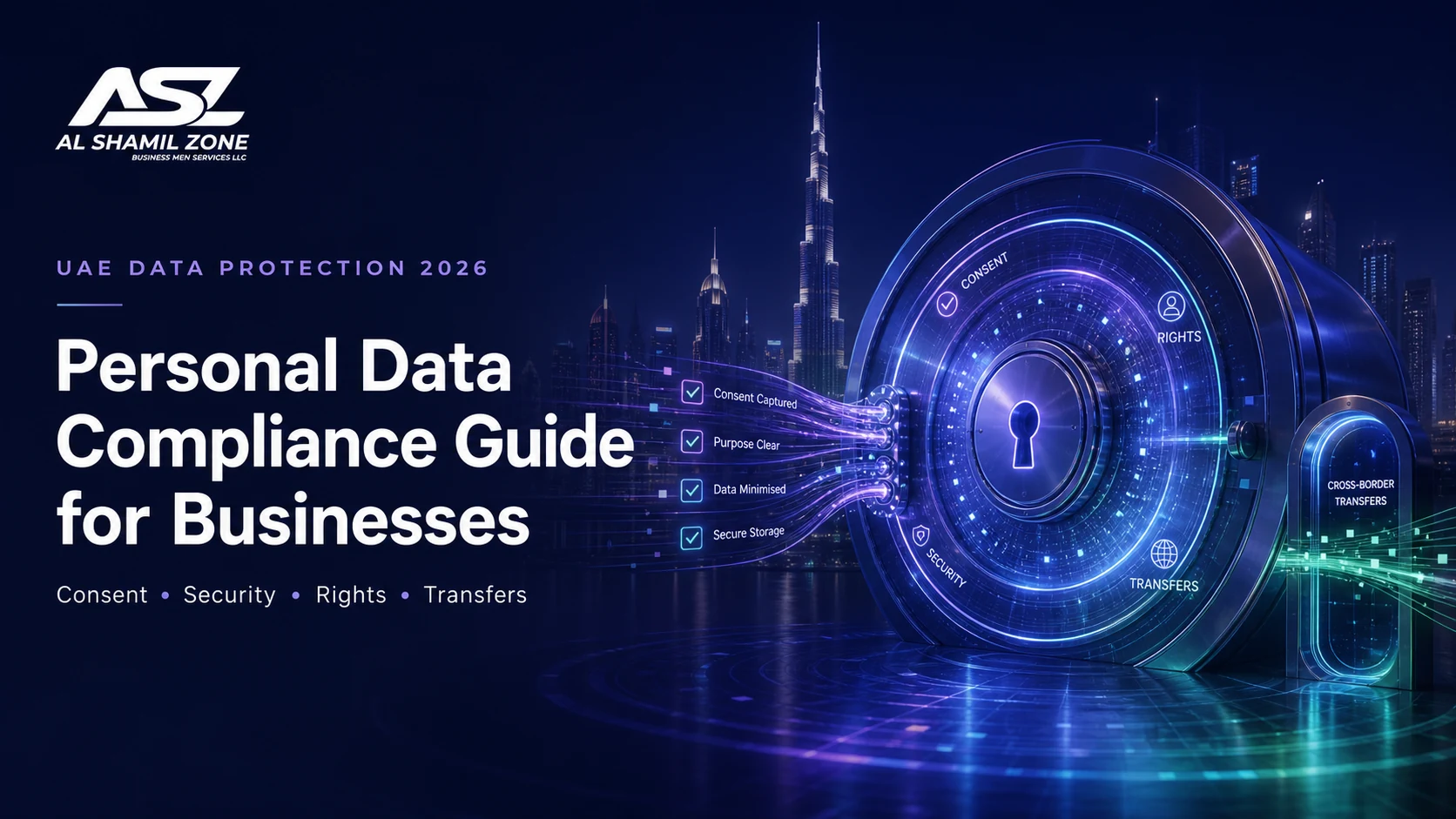
Almost every company processes personal data. Customer enquiries, employee files, website analytics, CCTV, supplier contacts, email marketing and cloud software can all involve information relating to an identifiable person. In the UAE, that makes data protection a practical governance issue, not merely an IT task or a privacy-policy paragraph.
Federal Decree-Law No. 45 of 2021 concerning the Protection of Personal Data provides the main federal framework. It came into force on 2 January 2022 and regulates electronic processing of personal data, establishes obligations for controllers and processors, grants rights to individuals and controls cross-border transfers. Businesses established in the DIFC or ADGM must separately consider those financial free zones' own data-protection regimes.
UAE data protection at a glance
| Area | Practical question |
|---|---|
| Scope | Which legal regime covers the entity and the processing? |
| Data inventory | What personal data is collected, from whom, why, where and for how long? |
| Lawful processing | What lawful basis supports each processing purpose? |
| Transparency | Are individuals clearly informed about how their information is used? |
| Security | Are technical and organisational measures proportionate to the risks? |
| Individual rights | Can the business receive, verify and answer rights requests? |
| Processors | Do vendor contracts and oversight protect the data? |
| Transfers | Is personal data sent abroad using a permitted mechanism? |
| Breaches | Can the business detect, assess, contain and report an incident? |
Which UAE data-protection regime applies?
The first compliance task is jurisdiction mapping. A mainland UAE company or an entity in a free zone without its own data-protection law will generally begin with the federal Personal Data Protection Law, subject to its scope and exclusions.
DIFC entities operate under DIFC Law No. 5 of 2020 and its regulations, administered by the DIFC Commissioner of Data Protection. ADGM entities are subject to the ADGM Data Protection Regulations 2021, administered by the ADGM Office of Data Protection. Both financial free-zone regimes include detailed accountability, notification, transfer and breach requirements.
A group may face more than one regime. For example, a mainland parent, DIFC subsidiary and ADGM service provider may each have different direct duties while sharing systems and customer information. International laws can also become relevant where overseas activities or customers trigger their territorial rules.
What counts as personal data?
Under the federal law, personal data includes information relating to a specific natural person or a person who can be identified directly or indirectly. Names and identification numbers are obvious examples, but electronic identifiers, location information, images, voices, contact details and combinations of otherwise ordinary facts can also identify a person.
Sensitive personal data deserves stronger attention. Health, biometric, genetic, religious, ethnic, criminal and certain other information may create higher risks and more restrictive requirements. A company should not assume that information is harmless merely because it is collected through a routine business system.
Controllers and processors
A controller determines the purpose and method of processing personal data. A processor handles data on the controller's behalf and under its instructions. A company can be a controller for some activities and a processor for others.
This distinction matters because responsibilities and contracts differ. An employer normally acts as controller for employee records. A cloud payroll provider may act as processor for the employer, while remaining a controller for its own billing, security or regulatory information.
Step 1: build a reliable data inventory
A privacy programme should start with facts. The business should map:
- Categories of individuals, such as leads, customers, employees and suppliers.
- Types of personal and sensitive data collected.
- Collection sources, including websites, forms, calls, apps and third parties.
- Purposes and lawful grounds for processing.
- Systems, departments and physical locations holding the data.
- Internal and external recipients.
- Countries to which data is accessed or transferred.
- Retention periods and deletion methods.
- Security controls and responsible owners.
A generic list of software is not enough. The map should explain the flow from collection to deletion. This record helps identify unnecessary data, inconsistent notices, unapproved vendors and international transfers that may otherwise remain invisible.
Step 2: define a lawful purpose and basis
Personal data should be collected for a specific and legitimate purpose and processed only as permitted by the applicable law. Consent is important but is not the only possible basis. The federal law provides exceptions and circumstances in which processing may occur without consent, including specified legal, contractual, employment, public-interest and rights-related situations.
Businesses should avoid using consent mechanically. Consent must satisfy legal requirements, and individuals should not be presented with misleading or bundled choices. If the true basis is performing a contract or complying with law, the documentation should reflect that analysis.
Purpose limitation also matters. Information collected to prepare a quotation should not automatically be reused for unrelated profiling or disclosed to another company simply because it is technically available.
Step 3: provide clear privacy information
People should understand who is processing their information, what is collected, why it is used, who receives it, how long it is kept, whether it is transferred and how rights can be exercised. The notice should be available when data is collected or within the legally appropriate timeframe.
A website privacy notice is only one layer. Recruitment forms, CCTV, customer onboarding, mobile apps, call recording and employee systems may require tailored information. Notices should match actual practices; copying language from another organisation can create contradictions rather than compliance.
Step 4: collect only what is necessary
Data minimisation reduces legal exposure and improves security. Each field should have a defensible purpose. If a company does not need a passport copy, date of birth or personal address for a particular service, collecting it “just in case” creates avoidable risk.
Retention should also be intentional. Legal, tax, employment, AML or contractual requirements may require certain records to be kept, but that does not justify indefinite retention of every email attachment or duplicate file. A retention schedule should specify the event that starts the period, responsible system and secure deletion method.
Step 5: keep data accurate and current
Inaccurate information can harm individuals and undermine business decisions. Reasonable processes should allow important customer, employee and beneficial-owner details to be corrected. Systems should avoid creating conflicting versions without a clear master record.
The required effort depends on the consequence of inaccuracy. A wrong marketing preference differs from an incorrect identity, payroll or compliance record. Higher-impact data requires stronger verification and change controls.
Step 6: implement security by design
The federal law requires controllers and processors to apply appropriate technical and organisational measures to protect personal data. Good security is risk-based and extends beyond antivirus software.
- Limit access according to job responsibilities.
- Use strong authentication and remove access promptly when roles change.
- Encrypt sensitive data where appropriate.
- Patch systems and monitor suspicious events.
- Control exports, downloads and portable media.
- Back up critical information and test restoration.
- Secure paper files and disposal.
- Assess privacy and security before launching new products or systems.
Data protection by design means considering privacy during planning, procurement and configuration, not after a system goes live. Default settings should collect, display and retain only what the intended purpose requires.
Step 7: govern vendors and cloud services
Outsourcing does not outsource accountability. Before a provider receives personal data, the business should understand where information will be hosted, who can access it, which sub-processors are used, how incidents are handled and what happens when the contract ends.
The agreement should address instructions, confidentiality, security, assistance with rights requests and breaches, deletion or return, audit evidence, sub-processing and international transfers as required by the applicable regime. High-risk suppliers deserve deeper due diligence and ongoing review.
Step 8: prepare for individual rights
The federal law gives data subjects rights that include obtaining information, requesting transfer in applicable circumstances, correcting or erasing personal data, restricting processing and objecting or stopping certain processing. Limits and exceptions may apply.
A company needs a workflow to receive a request, verify identity, locate relevant data, check exceptions, coordinate across systems and respond within the applicable rules. Staff should recognise a rights request even when the individual does not use legal terminology.
Step 9: control cross-border transfers
Cloud platforms and global support teams can transfer data even when nobody emails a spreadsheet abroad. Remote access, offshore hosting, international backups and foreign sub-processors should all be mapped.
The federal law controls transfers and sharing outside the UAE and provides mechanisms based on matters such as adequate protection, contractual safeguards and legally recognised exceptions. DIFC and ADGM maintain their own transfer frameworks, adequate-jurisdiction lists and contractual mechanisms.
The business should identify the originating regime, destination, recipient, transfer purpose, security and lawful mechanism before the transfer begins. A vendor's general promise of global compliance is not a substitute for this analysis.
Step 10: establish a breach-response plan
A personal-data breach can involve loss, unauthorised access, disclosure, alteration or destruction. It may arise from cyberattack, human error, misdirected email, stolen equipment, excessive permissions or a vendor incident.
The response plan should cover immediate containment, evidence preservation, impact assessment, legal analysis, internal escalation, regulatory and individual notifications where required, remediation and lessons learned. DIFC, ADGM and the federal framework may have different notification mechanics, so the applicable regime must be confirmed quickly.
Employees should know where to report an incident immediately. Delayed internal escalation can make containment and compliance much harder.
Do you need a data protection officer?
The federal law requires appointment of a data protection officer in specified higher-risk circumstances, including certain high-volume or sensitive processing. DIFC and ADGM have their own tests. Even where a formal appointment is not mandatory, the business should assign clear responsibility for privacy governance.
The responsible person needs adequate knowledge, access and independence. A title alone is insufficient if there is no authority to investigate problems, challenge risky processing or coordinate responses.
Common data-protection mistakes
- Assuming a privacy notice alone creates compliance.
- Collecting more identification documents than the service needs.
- Using consent for every activity without checking whether it is valid.
- Keeping former employee and rejected applicant data indefinitely.
- Buying cloud software without checking hosting and sub-processors.
- Sharing customer lists between group companies without analysis.
- Giving all staff broad access to CRM or HR information.
- Having no process for correction, deletion or access requests.
- Assuming DIFC, ADGM and federal requirements are identical.
- Waiting for a breach before assigning responsibilities.
A practical 2026 compliance checklist
- Identify every applicable data-protection regime and sector rule.
- Map personal data, purposes, systems, recipients and transfers.
- Document lawful grounds and consent where required.
- Update customer, employee, applicant and website notices.
- Reduce unnecessary collection and approve retention periods.
- Implement access, authentication, encryption and deletion controls.
- Review processor and cloud-provider due diligence and contracts.
- Document international transfer mechanisms.
- Create workflows for individual rights and identity verification.
- Establish and test the breach-response plan.
- Assess whether a DPO or impact assessment is required.
- Train staff and review compliance when systems or purposes change.
Official references
- UAE Legislation: Federal Decree-Law No. 45 of 2021
- Official UAE Government portal: Data protection laws
- UAE Legislation: Establishment of the UAE Data Office
- DIFC Commissioner of Data Protection
- DIFC data-protection guidance
- ADGM Office of Data Protection guidance
Need help organising your UAE business records, systems and compliance responsibilities? Call Al Shamil Zone on 800 2794, contact us through WhatsApp, or email info@shamilservices.ae.
This article provides general information and is not legal, cybersecurity or regulatory advice. Obtain advice based on the entity, jurisdiction, data, systems and processing involved.
Ready to get started? Contact Al Shamil Zone by phone at 800 2794, via WhatsApp at +971 54 586 6222, or email info@shamilservices.ae.