Can a UAE Free Zone Company Do Business on the Mainland?
Understand how UAE free-zone companies can access mainland markets through distributors, customs clearance, branches, companies and eligible operating permits.
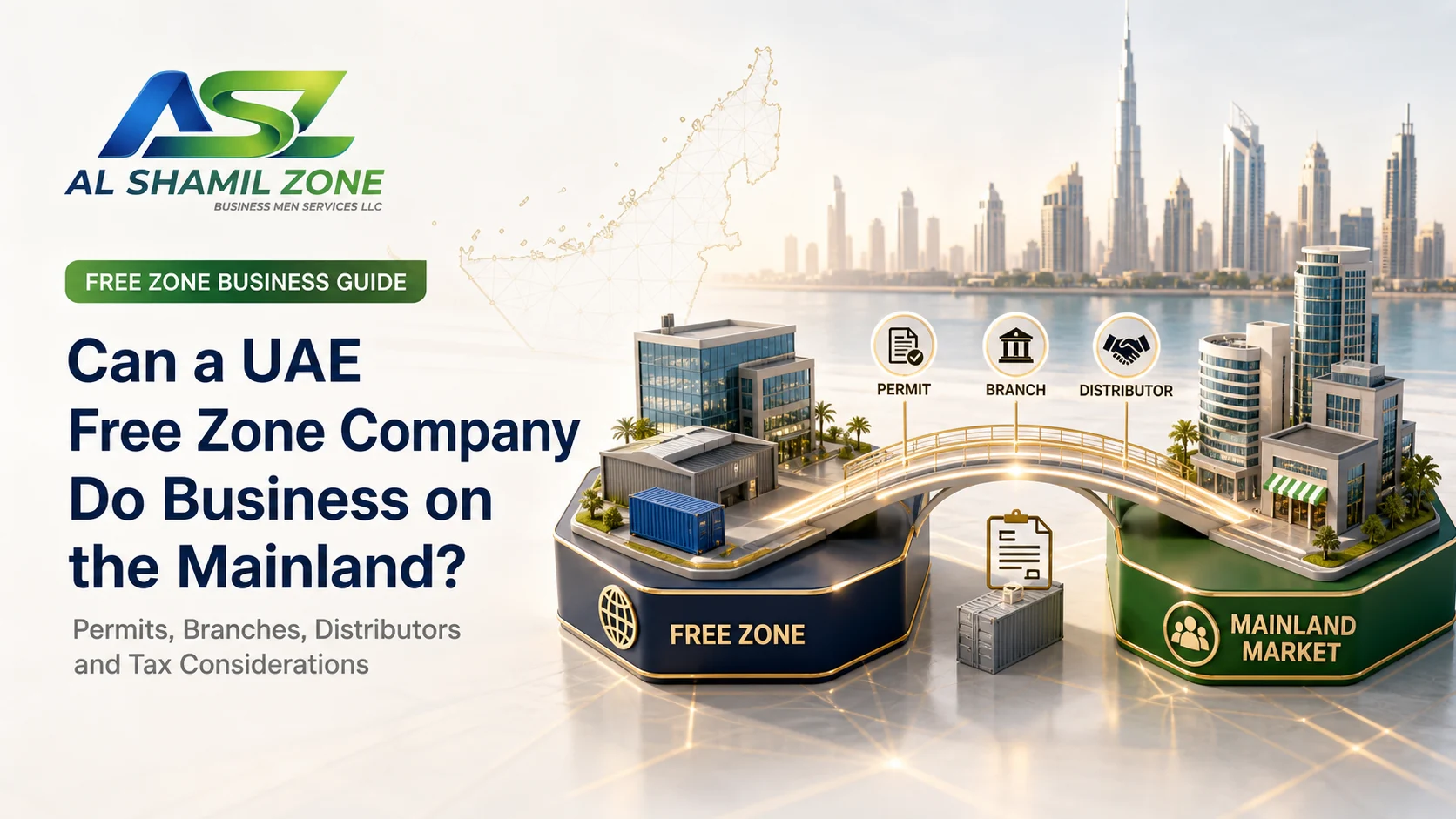
A UAE free-zone company can access mainland customers, but its free-zone licence is not automatically a licence to conduct every activity everywhere in the UAE. The lawful route depends on the emirate, activity, goods or services, operating location and the approvals available from the free-zone and mainland authorities.
Options can include appointing a licensed mainland distributor, clearing goods into the local market, establishing a mainland branch or company, or obtaining an eligible mainland operating permit. Dubai introduced a particularly important framework in 2025, but that framework applies within Dubai and does not create nationwide permission.
The short answer
Yes, with the correct route. A free-zone company can commonly:
- trade internationally and with businesses inside its free zone;
- sell goods into the mainland after completing the required customs and commercial arrangements;
- use a licensed mainland distributor or commercial channel;
- establish a mainland branch or separate mainland company;
- apply for a dual-licence or mainland permit where the relevant authorities offer one; or
- perform specific mainland activities under an approval designed for that purpose.
What it should not do is assume that a free-zone licence alone authorises an office, shop, warehouse, employees or regulated service activity outside the zone.
Having a mainland customer is not the whole test
Businesses often ask, “Can I invoice a mainland company?” The better question is: what activity will the free-zone company actually perform, where will it be performed, and under whose licence?
Important facts include:
- where the contract is negotiated and signed;
- where employees perform the core work;
- whether the company has an office, shop, warehouse or project site on the mainland;
- who imports and clears physical goods;
- who delivers, installs or maintains the goods;
- whether the customer is a consumer, company or government entity;
- whether the activity is regulated; and
- whether the free-zone authority has approved outside-zone operations.
A contract with a mainland customer does not automatically mean every operating model is prohibited. Equally, an online invoice does not cure an activity that requires a mainland licence, premises or regulator approval.
General UAE position
The UAE Government states that free-zone companies generally trade freely within their zone and internationally, while access to the mainland market is regulated. To sell goods or services locally, a business may need to work through a licensed mainland distributor or establish a mainland branch or company. Direct mainland activity generally requires the relevant licences or approvals.
Rules are administered at emirate and authority level. A Dubai permit does not authorise activity in Abu Dhabi, Sharjah or another emirate. Similarly, a procedure offered by one free zone may not be available to a company incorporated in another.
Route 1: Use a licensed mainland distributor
A distributor can buy, import or distribute products in the local market under its own appropriate licence. This route can be attractive when the free-zone company wants commercial reach without building a complete mainland operation.
The agreement should address:
- territory, products and sales channels;
- exclusive or non-exclusive appointment;
- importer-of-record and customs responsibilities;
- pricing, credit risk and payment currency;
- marketing approvals and brand use;
- product registration, warranties and recalls;
- minimum purchases and performance targets;
- customer data and after-sales support;
- termination and remaining stock; and
- whether commercial-agency registration is intended.
A distributor is not merely a name placed on an invoice. Verify its licence, authorised activities, customs capability and ability to meet sector-specific requirements.
Route 2: Import goods from the free zone into the mainland
Free-zone goods stored for re-export can benefit from customs treatment associated with the zone. When goods enter the UAE mainland market, the appropriate customs declaration, duty and import procedures apply.
Before selling physical goods locally, confirm:
- who is the importer of record;
- the customs code and registration used;
- tariff classification and customs value;
- country-of-origin and product labelling;
- municipality or product-registration approvals;
- restricted or controlled-goods requirements;
- VAT treatment on import and subsequent sale; and
- delivery, installation and warranty responsibilities.
Customs clearance solves the importation step; it does not necessarily authorise every retail, wholesale, installation or service activity on the mainland.
Route 3: Establish a mainland branch
A branch allows the same free-zone legal entity to conduct approved mainland activities through a mainland-licensed presence. The branch normally has no separate legal personality from its parent company.
A branch can be suitable where the business needs:
- a recurring physical mainland presence;
- premises or a customer-facing office;
- contracts requiring a mainland licence;
- regulated approvals linked to an onshore establishment;
- government or major-enterprise procurement eligibility; or
- separate operational accounting for mainland activity.
Confirm whether the activity can be licensed to a branch, whether a manager must be appointed, what premises are required and whether the free-zone authority must issue a no-objection approval.
Route 4: Establish a separate mainland company
A separate mainland company can provide clearer ownership, liability, staffing and commercial separation. It may be preferable where mainland operations will become a major business line, require additional shareholders or involve different risks.
However, two companies create related-party transactions. Agreements, charges, loans, intellectual-property use, management services and supply arrangements must be commercially documented and may be subject to UAE transfer-pricing requirements.
| Route | Best suited to | Main consideration |
|---|---|---|
| Mainland distributor | Product sales without a full local operation | Commercial control, margin and distributor capability |
| Customs-cleared sale | Goods moving from the zone into local circulation | Importer, duty, VAT and product approvals |
| Mainland branch | Recurring activity by the same legal entity | Activity eligibility, premises and separate records |
| Separate mainland company | Large or structurally distinct mainland operation | New entity, governance and related-party compliance |
| Activity permit or dual licence | Eligible activities under a specific authority programme | Scope, duration, location and renewal conditions |
Dubai's Free Zone Mainland Operating framework
Dubai Executive Council Resolution No. 11 of 2025 created a structured route for eligible establishments licensed in Dubai free zones to conduct activities outside the free zone and within Dubai after obtaining the required Dubai Department of Economy and Tourism licence or permit.
The Resolution provides three authorisation types:
- a licence to establish a branch within Dubai;
- a licence for a branch operating out of the free zone; or
- a permit to conduct specific activities within Dubai.
The two branch-licence types are stated to be valid for one year and renewable for the same period. The Resolution does not apply to financial establishments licensed in the Dubai International Financial Centre.
Common conditions include:
- a valid free-zone licence;
- approval from the relevant free-zone licensing authority;
- DET application and requested company documents;
- approval from the regulator supervising the activity where required;
- an eligible activity under the applicable list;
- payment of the prescribed fees; and
- compliance with applicable federal and local rules.
Dubai's six-month mainland operating permit
Dubai DET subsequently launched a Free Zone Mainland Operating Permit for eligible non-regulated activities. DET's official announcement describes a six-month permit costing AED 5,000, renewable for the same fee every six months.
The announcement states that participating free-zone companies can use their existing free-zone workforce for the mainland activity. It also emphasises separate financial records and Corporate Tax treatment for the mainland activities.
Availability is not automatic. Confirm:
- whether your free zone participates;
- whether the exact activity code is eligible;
- whether the activity is non-regulated or needs another approval;
- where and how the activity may be carried out;
- whether premises are permitted or required; and
- what invoices and records must identify the permit.
Operating outside Dubai
Dubai Resolution No. 11 of 2025 is an emirate-level framework. It expressly requires establishments wishing to operate outside Dubai to obtain the licences and permits required by the competent authority in that other jurisdiction.
For Abu Dhabi, Sharjah, Ajman, Ras Al Khaimah, Fujairah or Umm Al Quwain, check the current economic-department and free-zone procedures. Do not assume that a Dubai branch, permit or customer contract authorises a physical operation in another emirate.
Services versus goods
The correct mainland route can differ substantially:
Professional and consultancy services
Review where personnel perform the work, whether the activity is regulated and whether a project site or permanent office is involved. Engineering, healthcare, education, legal, financial and other regulated services can require external approvals.
Trading and e-commerce
Identify the seller, importer, warehouse, fulfilment provider and party named on the customer invoice. An online storefront does not remove customs, consumer-protection, product and licensing obligations.
Installation and maintenance
Selling equipment is different from sending technicians to install or service it. Confirm that the licence covers the after-sales activity and that the workers are authorised to perform it at the mainland location.
Retail, restaurant and consumer-facing activity
A physical outlet normally requires premises and local permits. Food, signage, building, safety and municipality approvals may apply in addition to the economic licence.
Can existing free-zone employees work on the mainland?
Do not assume that a free-zone visa allows employees to work at any mainland site. The licensing and labour position should be checked together.
Under Dubai's Resolution, an establishment authorised through the framework may engage its existing workforce registered on the free-zone portal and continue to benefit from the relevant free-zone employment privileges. The scope of the authorised activity and any workplace or sector requirements still apply.
Outside that framework, obtain confirmation from the relevant free zone, labour authority and mainland licensing body before deploying staff.
Corporate Tax consequences
A free-zone licence does not guarantee that all income receives a 0% Corporate Tax rate. The 0% rate is available only to a Qualifying Free Zone Person on Qualifying Income when all statutory conditions are met.
The FTA explains that where a Qualifying Free Zone Person operates through a domestic permanent establishment outside the free zone, profit attributable to that permanent establishment is subject to the 9% Corporate Tax rate.
Mainland expansion can therefore affect:
- classification of income as qualifying or non-qualifying;
- domestic permanent-establishment analysis;
- the de minimis test;
- adequate-substance requirements;
- transfer pricing between related entities or business segments;
- allocation of revenue, people, assets and expenses; and
- audited financial-statement and record-keeping obligations.
Obtain tax advice before choosing the legal route—not after the first mainland invoice is issued.
Separate financial records
Dubai's 2025 Resolution requires a permitted or licensed free-zone establishment to keep records for activities conducted outside the free zone separate from those kept for activities inside it.
A practical accounting design should separately identify:
- mainland and free-zone revenue;
- direct staff, premises and selling costs;
- shared-cost allocation methods;
- inventory movements and customs declarations;
- related-party charges;
- VAT place-of-supply and import records; and
- assets used by each operation.
Set up cost centres and invoice rules before trading begins. Reconstructing the separation at year-end is slower and less reliable.
VAT and customs
Free-zone and mainland labels do not by themselves determine VAT treatment. For VAT purposes, special rules apply to designated zones and certain supplies of goods, while many services follow the normal UAE VAT rules.
Review:
- whether the zone is a designated zone for VAT purposes;
- whether goods physically move into the mainland;
- who pays import VAT and customs duty;
- whether the supply is standard-rated, zero-rated or outside scope;
- the correct invoice and TRN; and
- whether a branch and head office form the same taxable person.
Do not market a free-zone sale as automatically VAT-free.
Banking, contracts and invoicing
Before launch, provide the bank, payment provider and major customers with the complete structure: free-zone licence, mainland permit or branch licence, approvals, contracts and expected payment flows.
Contracts and invoices should clearly state:
- the correct legal entity;
- the relevant branch or permit details;
- the authorised activity;
- the supply and delivery location;
- customs and importer responsibility;
- VAT treatment and TRN; and
- payment account and currency.
A mismatch between the contracting entity, licence, invoice and bank account can delay customer onboarding and payments.
Government and regulated-sector contracts
Some tenders require a mainland registration, local establishment, specific activity, chamber membership, classification certificate or prior operating history. A general permit may not satisfy every procurement condition.
Regulated sectors can require approval from health, education, financial, legal, transport, food, media, municipality or other authorities. Always obtain the regulator's position in addition to the economic licence.
Common mistakes
- Assuming any free-zone licence allows direct mainland operations.
- Confusing a mainland customer with permission for a mainland office or worksite.
- Treating customs clearance as a complete commercial licence.
- Using a Dubai permit to operate in another emirate.
- Choosing a distributor without checking its activity and customs capability.
- Sending employees to mainland sites without confirming the labour position.
- Ignoring regulated-activity and municipality approvals.
- Believing all free-zone income automatically receives 0% Corporate Tax.
- Mixing mainland and free-zone records.
- Using the wrong company, licence or TRN on contracts and invoices.
Decision checklist
- Describe the exact goods or services.
- Identify every emirate and physical location involved.
- Map the customer, seller, importer and service-delivery roles.
- Confirm the free-zone activity and obtain its written approval.
- Check mainland activity eligibility and external approvals.
- Compare distributor, permit, branch and separate-company routes.
- Review premises, workforce and visa requirements.
- Model customs, VAT and Corporate Tax consequences.
- Design separate accounting records.
- Align contracts, invoices and banking.
- Apply before beginning the mainland activity.
- Calendar permit, branch and approval renewals.
Official references
- UAE Government: Running a business in a free zone
- Dubai Executive Council Resolution No. 11 of 2025
- Dubai DET: Free Zone Mainland Operating Permit
- Federal Tax Authority: Corporate Tax guide for Free Zone Persons
Need help choosing the right mainland-access route? Call Al Shamil Zone on 800 2794, contact us through WhatsApp, or email info@shamilservices.ae.
This article provides general information and is not legal, customs or tax advice. Permission depends on the company, free zone, emirate, activity and operating facts. Obtain written authority confirmation and professional advice before trading.
Ready to get started? Contact Al Shamil Zone by phone at 800 2794, via WhatsApp at +971 54 586 6222, or email info@shamilservices.ae.