UAE eInvoicing Deadline: What AED 50 Million+ Businesses Must Do Before 30 October 2026
AED 50 million+ UAE businesses must appoint an Accredited Service Provider by 30 October 2026. Use this ASP selection and implementation checklist.
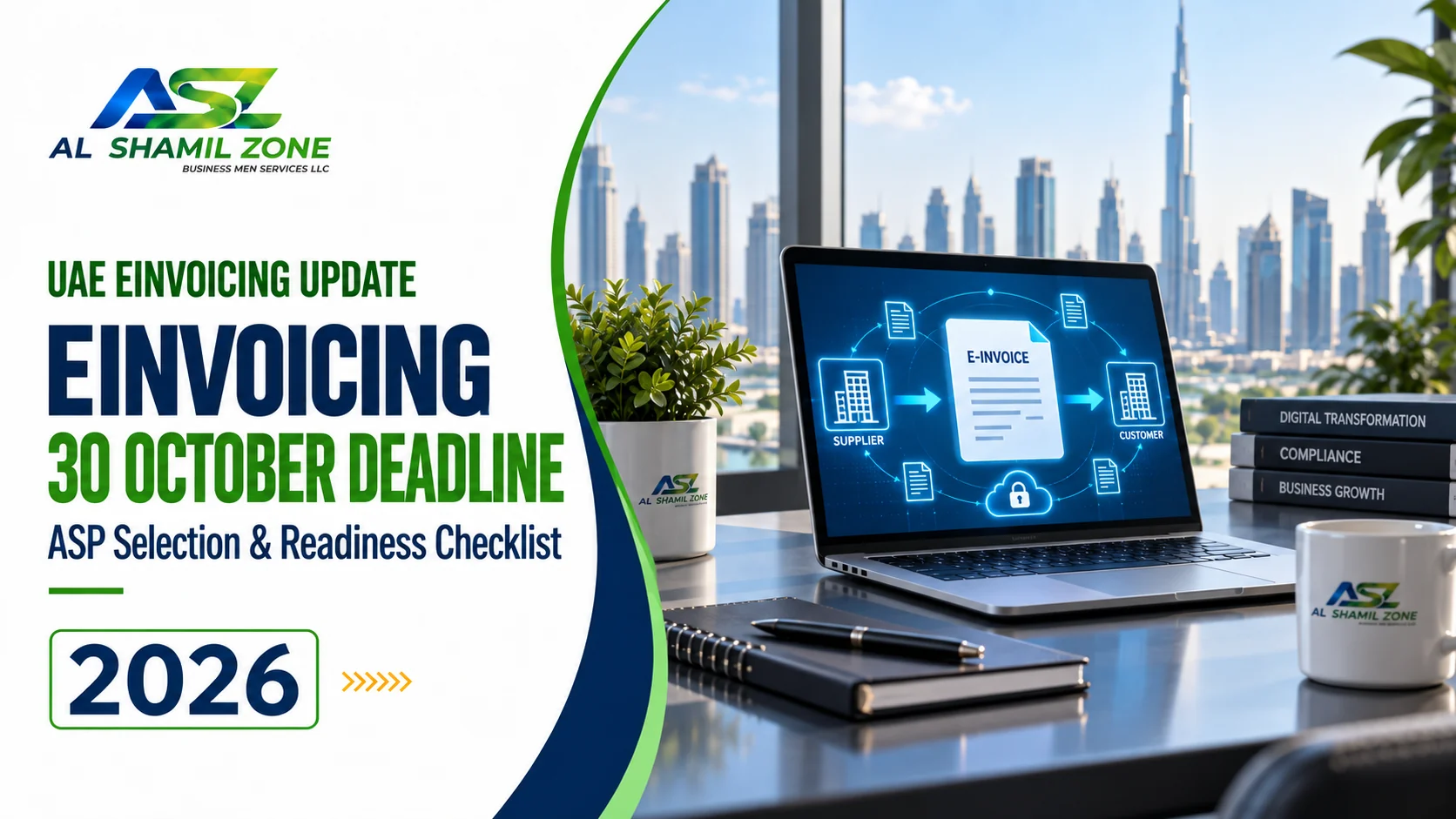
UAE businesses with annual revenue of AED 50 million or more must appoint an Accredited Service Provider for eInvoicing by 30 October 2026. Mandatory Phase One implementation remains scheduled for 1 January 2027.
The Ministry of Finance reconfirmed both dates on 27 September 2026 after the UAE eInvoicing Pilot Phase moved into practical testing. For businesses in the first mandatory phase, the remaining work is not limited to signing a service-provider agreement. Finance, tax, IT, procurement and sales teams need to prepare invoice data, connect systems, test exchanges and establish controls before going live.
The two dates Phase One businesses must know
- 30 October 2026: deadline to appoint an Accredited Service Provider (ASP).
- 1 January 2027: mandatory eInvoicing implementation begins for businesses with annual revenue of AED 50 million or more.
The ASP appointment deadline was extended from 31 July to 30 October 2026. The implementation date was not extended. This distinction matters: the additional time is for selecting and appointing the provider, while technical readiness must still be achieved for January.
Who is affected by the 30 October 2026 deadline?
The deadline applies to a Person subject to the UAE eInvoicing system whose annual revenue is AED 50 million or more. The official guidelines define revenue as the gross income earned during the most recent Accounting Period, based on financial statements prepared under applicable UAE legislation or, where those statements are unavailable, other documentation acceptable to the Federal Tax Authority.
Businesses close to the threshold should document how the revenue figure was determined. Groups should not assume that one VAT-group registration automatically answers the test for every legal entity; the entity structure, the definition of Person and the applicable records should be reviewed carefully.
UAE eInvoicing implementation timeline
| Category | ASP appointment deadline | Mandatory implementation |
|---|---|---|
| Annual revenue of AED 50 million or more | 30 October 2026 | 1 January 2027 |
| Annual revenue below AED 50 million | 31 March 2027 | 1 July 2027 |
| Government entities | 31 March 2027 | 1 October 2027 |
The Ministry may issue further amendments or operational guidance. Businesses should verify the latest position on the official eInvoicing portal before acting on a general timeline.
What counts as an eInvoice in the UAE?
An eInvoice is structured invoice data issued, exchanged and reported electronically through the UAE eInvoicing framework. A PDF attachment, scanned invoice, image, spreadsheet or invoice sent by email is not, by itself, an eInvoice.
The UAE system uses an XML format and the Peppol-based PINT-AE specification. This allows invoice data to move between suppliers, buyers and their ASPs in a standardised form while tax data is reported through the fifth corner of the model.
Electronic Invoicing is broader than VAT registration. The official guidelines state that Persons conducting Business in the UAE can be in scope regardless of VAT registration status, subject to the phased dates and stated exclusions.
How the UAE 5-Corner Model works
- Corner 1 — Supplier: creates invoice data in its accounting, ERP or invoicing system.
- Corner 2 — Supplier's ASP: validates the data, converts it to the UAE XML standard where required and transmits it.
- Corner 3 — Buyer's ASP: receives and validates the eInvoice.
- Corner 4 — Buyer: receives the invoice through its agreed system or process.
- Corner 5 — Government platform: receives the required tax data and returns electronic confirmations.
The ASP handles secure transmission and technical interoperability, but the business remains responsible for accurate invoice values, complete source data and compliance with its obligations.
30 October readiness checklist
- Confirm whether annual revenue meets the AED 50 million threshold.
- Identify every legal entity and business process that may be in scope.
- Shortlist providers from the official Accredited Service Provider list.
- Complete commercial, security, data-residency and service-level due diligence.
- Appoint the ASP through a signed agreement by the deadline.
- Initiate the ASP onboarding process through EmaraTax.
- Map invoice and credit-note flows across sales, procurement and intercompany processes.
- Compare existing ERP fields with the UAE mandatory data requirements.
- Clean customer, supplier, tax and legal-registration master data.
- Build and test the technical connection with the ASP.
- Test validation failures, rejected invoices, corrections and credit notes.
- Train finance, tax, sales, procurement, customer-service and IT teams.
- Approve the go-live plan, support model and contingency procedures.
How to select an Accredited Service Provider
The cheapest proposal is not necessarily the lowest-risk implementation. The selected ASP becomes a critical connection between the company's invoice systems, counterparties and the UAE reporting framework.
Verify official accreditation
Use the current provider list published through the Ministry of Finance eInvoicing portal. Confirm the legal entity named in the agreement matches the accredited provider or an arrangement expressly permitted by the applicable framework.
Check ERP and accounting integration
Ask whether the ASP has a proven connector for the business's ERP or invoicing platform. If custom integration is required, define who will build, test and maintain it. Consider subsidiaries using different systems, high-volume billing engines, point-of-sale environments and manual invoice processes.
Assess security and data governance
Review encryption, access controls, incident response, business continuity, subcontractors, data location, retention, deletion and audit rights. The contract should clearly allocate responsibility for security events and service interruptions.
Review validation and exception handling
A good implementation must handle more than successful invoices. Request demonstrations of validation errors, buyer-identifier failures, duplicate prevention, rejected documents, cancellations, partial credit notes and corrections.
Confirm reporting and support
Businesses need visibility over delivery status, acknowledgements, failures and unresolved exceptions. Confirm operating hours, escalation paths, response times, implementation support and the reporting available to finance and tax teams.
Understand the complete price
Compare implementation fees, subscription charges, transaction tiers, connector costs, storage, support, change requests and exit assistance. A low headline price can become expensive if essential integration or support is excluded.
EmaraTax onboarding: who starts the process?
The official guidelines state that onboarding with an ASP should be initiated by the Person or Government Entity through EmaraTax, not by the ASP. The business selects the provider, completes the necessary authorisation and works with that provider on technical onboarding.
Confirm that the authorised user can access the correct taxable-person profile and that corporate records are current. Waiting until the final days to resolve expired identification, old authorised signatories or inaccessible accounts can delay appointment.
Invoice data that businesses should prepare
The exact mandatory fields depend on document type and transaction scenario, but readiness normally requires clean and consistent information covering:
- supplier and buyer legal names and addresses;
- Tax Registration Numbers and Tax Identification Numbers where applicable;
- trade-licence or other legal-registration information;
- invoice number, issue date, currency and payment details;
- line-item descriptions, quantities, units and prices;
- discounts, allowances, charges and rounding;
- tax category, taxable amount, tax rate and tax amount;
- references to contracts, purchase orders or preceding invoices where required;
- credit-note reasons and references; and
- the buyer's electronic address or Peppol participant identifier.
Data quality is often the longest part of implementation. A technically correct connection will still reject or misroute invoices when customer records, tax categories or legal identifiers are incomplete.
Processes that need special testing
- advance payments, deposits and milestone billing;
- recurring invoices and consolidated billing;
- self-billing and billing-agent arrangements;
- exports and foreign customers;
- zero-rated, exempt and out-of-scope transactions;
- mixed supplies and multiple tax categories;
- credit notes, cancellations, refunds and price adjustments;
- foreign currency and exchange-rate treatment;
- intercompany recharges and VAT-group transactions; and
- system downtime and manual contingency procedures.
The June 2026 guidelines describe a temporary 24-month grace period from 1 January 2027 for business transactions between members of the same VAT group. This affects timing for those intra-group transactions; it does not remove other in-scope transactions from the applicable implementation phase.
Four-week implementation plan
Week 1: scope and provider decision
Confirm the revenue threshold, entities, systems and transaction types. Issue a focused request for information to shortlisted ASPs, evaluate accreditation and integration capability, and agree the internal decision process.
Week 2: contract and data mapping
Complete commercial and security review, sign the ASP agreement, initiate EmaraTax onboarding and map source-system data to the UAE eInvoice fields. Assign owners for missing or unreliable data.
Week 3: integration and testing
Configure the connector or API, test representative invoice types and verify acknowledgements. Include rejection, correction and credit-note scenarios rather than testing only standard sales invoices.
Week 4: controls and go-live preparation
Resolve defects, train users, approve reconciliations and exception reports, confirm support arrangements and document the cutover and contingency plan. Management should receive a clear readiness status before 1 January.
Common mistakes to avoid
- Treating the ASP appointment deadline as the system go-live date.
- Assuming PDF invoices sent by email meet the eInvoicing requirement.
- Selecting a provider without confirming current official accreditation.
- Leaving master-data cleanup until technical testing.
- Testing only successful domestic VAT invoices.
- Ignoring received invoices and accounts-payable processes.
- Assuming the ASP takes over the business's compliance responsibility.
- Failing to establish monitoring, reconciliation and exception ownership.
Frequently asked questions
Was the UAE ASP deadline extended?
Yes. For Persons with annual revenue of AED 50 million or more, the ASP appointment deadline was extended from 31 July 2026 to 30 October 2026. The mandatory implementation date remains 1 January 2027.
Is a PDF invoice an eInvoice?
No. A PDF, scan, image, Word document or email is not a structured eInvoice. The UAE framework uses structured XML data exchanged through Accredited Service Providers.
Does eInvoicing apply only to VAT-registered businesses?
No. The official scope is not determined only by VAT registration. Persons conducting Business Transactions in the UAE may be in scope regardless of VAT status, subject to the phased implementation dates and exclusions.
Can a business appoint more than one ASP?
The official guidelines state that a Person in scope must appoint one ASP for both sending and receiving eInvoices. Businesses with complex groups should confirm how the rule applies across their legal entities and systems.
Is voluntary implementation available?
Yes. The voluntary phase began on 1 July 2026. A business choosing early implementation must still follow the technical requirements, while eInvoicing-specific administrative penalties apply from its mandatory implementation date.
Do not stop at signing the ASP contract
The 30 October deadline is a procurement and compliance milestone, not the end of the project. A business is ready only when its data, systems, people and controls can create, exchange, receive, report and reconcile eInvoices reliably.
For broader background, read our UAE eInvoicing business-readiness guide. Al Shamil Zone can also support accounting-process reviews, tax compliance coordination and implementation readiness. Contact our team to discuss the requirements relevant to your business.
Official sources
- Ministry of Finance: Latest eInvoicing update, 27 September 2026
- Ministry of Finance: ASP deadline extension
- Ministry of Finance: Official UAE eInvoicing portal
- UAE Electronic Invoicing Guidelines, Version 1.1
Reviewed on 28 September 2026. This article provides general information and is not legal or tax advice. The scope and implementation requirements depend on the facts of each Person, and official decisions or guidance may change.
Ready to get started? Contact Al Shamil Zone by phone at 800 ASZG (2794), via WhatsApp at +971 54 586 6222, or email info@shamilservices.ae.