Branch Office vs Subsidiary in Dubai: Which Structure Should You Choose?
Compare a Dubai branch of a foreign company with a separate UAE subsidiary across legal identity, liability, activities, documentation, tax and growth flexibility.
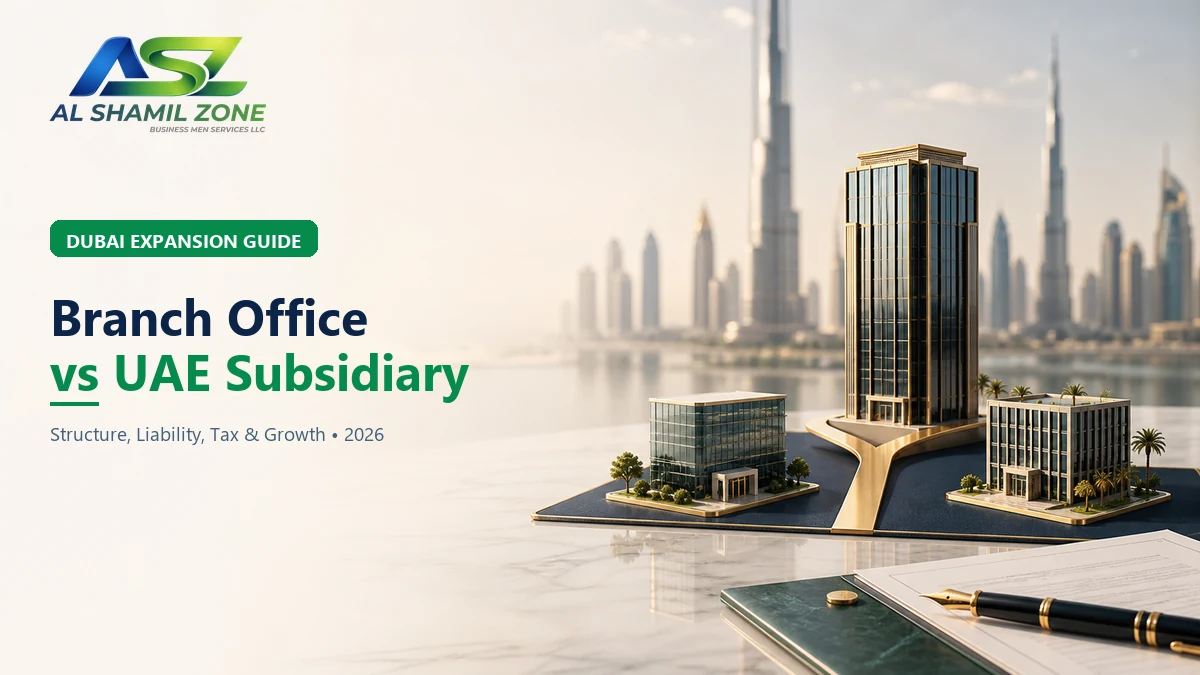
A foreign company expanding into Dubai commonly considers two structures: registering a branch of the existing overseas company or incorporating a new UAE subsidiary. Both can provide a licensed Dubai presence, but they differ materially in legal identity, liability, permitted activities, ownership records, banking and future investment.
What is a Dubai branch office?
A branch is an extension of its foreign parent rather than a separate incorporated company. It generally carries on activities approved under its Dubai licence in the parent company's name. The parent remains responsible for branch obligations.
The UAE Commercial Companies Law no longer requires a foreign-company branch to appoint a UAE national agent. Activity-specific requirements and approvals can still apply.
What is a UAE subsidiary?
A subsidiary is a separate UAE legal entity owned wholly or partly by the foreign parent. A limited liability company is a common mainland form, while Free Zone companies are also available where their operating model fits the business.
The subsidiary has its own constitutional documents, ownership record, licence, accounts and contractual identity. The UAE permits 100% foreign ownership for many mainland activities, subject to restrictions and special requirements for activities of strategic impact.
Branch office vs subsidiary: key differences
| Issue | Foreign-company branch | UAE subsidiary |
|---|---|---|
| Legal identity | Extension of the foreign parent | Separate UAE legal entity |
| Liability | Generally rests directly with the parent | Generally contained within the subsidiary, subject to law and guarantees |
| Ownership | No shares in the branch | Shares or ownership interests issued in the UAE entity |
| Activities | Usually aligned with the parent and approved branch activities | Activities selected for the UAE entity and approved by its authority |
| Investors | Cannot issue branch equity to a new investor | Can admit shareholders subject to approvals and documents |
| Sale or exit | Transfer usually involves the parent or branch closure/restructuring | Shares may be transferred subject to law and authority procedures |
| Branding | Closely tied to the foreign parent name | Can use a distinct approved UAE trade name |
When can a branch be the better option?
A branch may suit a well-established foreign company that wants to perform the same or closely related activity in Dubai, retain a single group identity and accept direct parent-company responsibility. It can be especially relevant where clients expect contracts with the established parent.
However, the parent must usually provide corporate documents, a board resolution and powers of attorney that are certified, legalised and translated as required. This can make preparation more involved than incorporating a straightforward new company.
When can a subsidiary be preferable?
A subsidiary may be more suitable when the group wants:
- a separate UAE risk and contracting vehicle;
- local or future co-investors;
- a business model or activity range different from the parent;
- clearer transfer, fundraising or exit options;
- a distinct UAE brand and management structure; or
- greater flexibility to retain profits and reinvest locally.
Documents for a foreign-company branch
Current Ministry of Economy and Tourism guidance identifies documents including:
- trade-name reservation or initial approval from the competent licensing authority;
- official incorporation and commercial-registration evidence for the parent;
- the parent company's constitutional documents;
- a board resolution approving the branch and appointing its manager;
- authorisation for the person handling the application;
- passport and identification documents for the responsible manager; and
- activity-specific government approvals where applicable.
Foreign corporate records normally require the applicable chain of certification or legalisation and Arabic legal translation. The exact process depends on the issuing country and document.
Typical branch registration sequence
- Confirm that the proposed activity is available to a branch.
- Reserve the name and obtain initial licensing-authority approval.
- Prepare and legalise the parent-company documents and board resolution.
- Apply for the required Ministry approval or registration.
- Secure premises and any activity-specific approvals.
- Complete the Dubai licence, chamber and establishment registrations.
- Arrange immigration, labour, tax, customs and banking registrations as relevant.
Tax, accounts and banking
Both structures require a proper UAE Corporate Tax analysis. A branch can constitute a UAE permanent establishment of the foreign parent, while a subsidiary is generally a UAE resident juridical person. Group transactions, management charges, financing and transfer pricing require careful treatment.
Neither structure guarantees a bank account. Banks assess ownership, controllers, business activity, customers, transaction countries, source of funds, premises and expected turnover. A branch may also be asked for detailed parent-company financial and corporate records.
Common decision mistakes
- choosing a branch only because it appears faster;
- assuming the parent company's activities will all be approved in Dubai;
- ignoring the parent's direct liability for branch obligations;
- forming a subsidiary without planning intercompany agreements and transfer pricing;
- overlooking legalisation time for foreign documents; and
- selecting a Free Zone entity without mapping how it will conduct mainland business.
Official references
- Ministry of Economy and Tourism: Foreign-company branch initial approval
- Ministry of Economy and Tourism: No national-agent requirement
- UAE Government: Full foreign ownership
Compare the structures before applying
Al Shamil Zone can coordinate the activity assessment, document checklist, legalisation workflow and licensing process for a Dubai branch or subsidiary.
Speak with our team: call +971 4 408 1900, contact us through WhatsApp, or submit an enquiry.
This article is general information and not legal, tax, accounting or investment advice.
Ready to get started? Contact Al Shamil Zone by phone at 800 ASZG (2794), via WhatsApp at +971 54 586 6222, or email info@shamilservices.ae.