VAT Deregistration in the UAE: When and How to Cancel Your Registration
Learn when UAE VAT deregistration is mandatory or voluntary, what evidence the FTA requires, how to apply through EmaraTax and complete the final return.
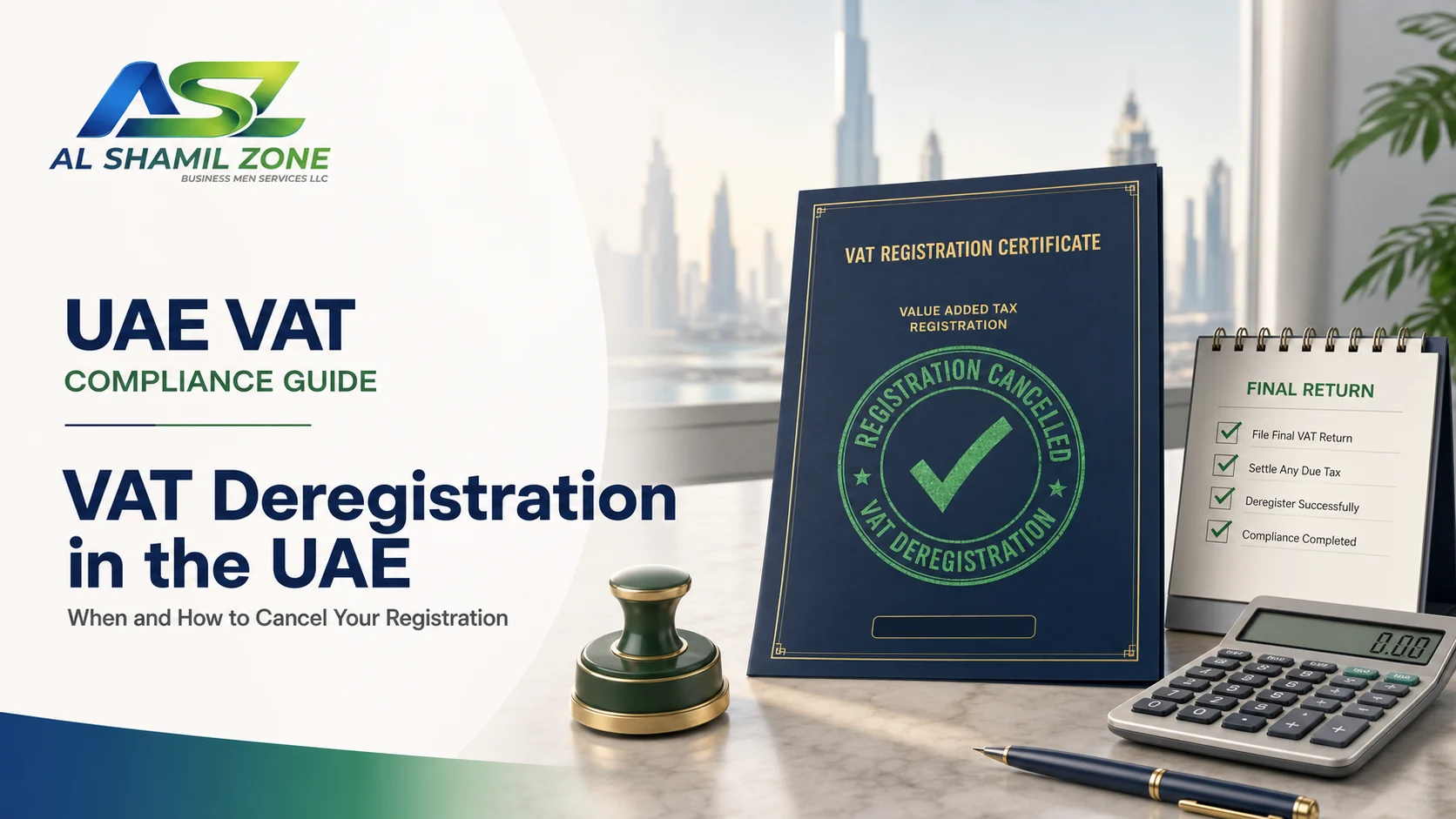
Closing a company, cancelling a trade licence or falling below the VAT threshold does not automatically cancel a UAE VAT registration. A registered person must assess whether deregistration is mandatory or optional, submit the correct request through EmaraTax and complete the final VAT obligations.
The timing matters. When deregistration is mandatory, the Federal Tax Authority requires the application within a prescribed deadline. Filing too early, selecting the wrong reason or submitting incomplete financial evidence can delay the request.
VAT deregistration is not the same as company cancellation
These are separate procedures:
- Trade-licence cancellation or liquidation closes or changes the commercial registration through the licensing authority.
- VAT deregistration ends the person's VAT registration following FTA review and approval.
- Corporate Tax deregistration is another separate FTA process where the person is registered for Corporate Tax.
A business may therefore have a cancelled licence but still have an active Tax Registration Number, pending returns and outstanding VAT liabilities. Coordinate the commercial, immigration and tax closure workstreams rather than treating one approval as completing all of them.
When is VAT deregistration mandatory?
Under the VAT legislation, a registrant must apply for deregistration when:
- the person stops making taxable supplies; or
- taxable supplies during the preceding 12 consecutive months are below the voluntary-registration threshold and the relevant forward-looking registration condition is not met.
The current voluntary-registration threshold is AED 187,500. The FTA will consider historical supplies and the expected position, not only one quiet month or a temporary fall in revenue.
According to the current FTA service information, a mandatory deregistration application must be submitted within 20 business days from the date the obligation to deregister begins.
When can deregistration be voluntary?
A registrant may apply voluntarily when taxable supplies during the previous 12 months are below the mandatory-registration threshold of AED 375,000, even if they remain above the voluntary threshold.
Voluntary deregistration is not automatic. The FTA reviews whether the statutory conditions are met and determines the effective date. A person who registered voluntarily generally cannot request deregistration within 12 months of the registration date.
| Business position | General VAT treatment |
|---|---|
| No longer makes taxable supplies | Mandatory deregistration may apply |
| Past 12 months below AED 187,500 and future condition not met | Mandatory deregistration may apply |
| Past 12 months between AED 187,500 and AED 375,000 | Voluntary application may be possible |
| Past or expected supplies meet the mandatory threshold | Registration will generally need to continue |
| Temporary slowdown only | Not enough by itself; assess the complete statutory test |
The VAT calculations can be more complex for zero-rated supplies, imports, tax groups, branches, sole establishments, asset sales and changes of legal ownership. Do not use the table as a substitute for a transaction-level review.
What date triggers the 20-business-day period?
The trigger is the date the registrant becomes required to deregister, not necessarily the date the trade licence is cancelled or the date management decides to close.
Depending on the reason, evidence may need to establish:
- the final taxable supply date;
- the date business activities ceased;
- the licence cancellation, liquidation, sale or ownership-change date;
- the 12-month taxable-supply calculation; and
- whether taxable supplies or taxable expenses are expected during the next 30 days.
Prepare a dated chronology before starting the EmaraTax form. An unsupported effective date is a common reason for questions from the FTA.
Documents commonly required
The documents depend on the selected basis and sub-reason. The current FTA service card lists examples including:
- cancelled trade licence, liquidation letter or board resolution;
- latest trial balance, profit-and-loss statement or balance sheet;
- turnover templates showing taxable income and expenses from the effective registration date;
- old and amended sale agreements or company documents when a business or licence is sold;
- evidence that a natural person stopped the activity;
- a signed declaration about expected taxable supplies during the next 30 days;
- business-flow information, customer and supplier locations and sample invoices where supplies are exempt or outside the scope;
- employment information where requested; and
- details of duplicate TRNs, branches or sole establishments where relevant.
Figures should reconcile with VAT returns, financial statements, bank transactions, invoices and customs records. If the business has corrected earlier returns or submitted voluntary disclosures, keep those reconciliations with the deregistration file.
Step-by-step VAT deregistration process
1. Confirm eligibility and the correct basis
Review taxable supplies for the relevant 12-month period, expected supplies and taxable expenses. Decide whether the request is mandatory or voluntary and document why.
2. Bring VAT compliance up to date
Review all filed returns, payments, penalties, refunds and correspondence. Identify unfiled returns or errors before they interrupt the deregistration process.
3. Prepare the turnover reconciliation
Reconcile sales by tax treatment: standard-rated, zero-rated, exempt and outside the scope. Explain differences between turnover in the accounts and taxable supplies reported in VAT returns.
4. Collect closure or threshold evidence
Prepare the specific documents for the selected reason. Use current, signed and internally consistent documents. The FTA currently accepts common image and PDF formats subject to its file-size rules.
5. Apply through EmaraTax
Sign in to the taxable person's EmaraTax account, open the VAT registration, select Actions, choose De-Register, complete the form and upload the evidence.
6. Monitor messages and respond promptly
The FTA may request clarification, corrected forms or additional evidence. Monitor both the EmaraTax dashboard and the registered email address. A resubmitted request may require a further review period.
7. Submit the final return and clear liabilities
After review, the account may show that the final VAT return and outstanding liabilities must be completed. Do not assume submission of the application ends the duty to charge, report or pay VAT.
8. Complete deregistration and download the certificate
Once the FTA approves the request and all required steps are completed, download and retain the VAT Deregistration Certificate from the account dashboard.
How long does FTA review take?
The current FTA service card gives an estimated review time of 20 business days from receipt of a completed application. If more information is requested, the FTA may take a further review period after resubmission.
This is an estimated service period, not a guarantee. Incomplete evidence, unreconciled returns, unpaid amounts and complex transactions can extend the process.
The final VAT return
The FTA states that the final return must be submitted and payable tax settled no later than 28 days from the effective date of deregistration, corresponding to the end of the final tax period.
The final return may need to address:
- sales and purchases up to the effective date;
- credit notes and bad-debt adjustments;
- import VAT and reverse-charge transactions;
- input-tax corrections;
- deemed supplies or assets retained at deregistration;
- capital-asset scheme adjustments where applicable; and
- outstanding tax, penalties or approved refunds.
Closing the bank account too early can make tax payments, refunds and evidence collection harder. Keep access to records and payment facilities until the tax position is settled.
What happens to stock and business assets?
Goods and assets held when registration ends can create VAT consequences where input tax was recovered. The analysis depends on the asset, its use, value, prior recovery and the way the business is transferred or closed.
Before disposing of records or distributing assets to owners, list:
- inventory and work in progress;
- vehicles, equipment and furniture;
- property interests and fit-out assets;
- software, licences and other intangible assets;
- receivables, deposits and advances; and
- assets transferred with a sold business.
Obtain tax advice before the closing transactions are executed. The sequencing can affect the VAT treatment.
Can a business continue issuing VAT invoices?
Until the effective deregistration date, the registrant must continue applying the VAT rules to taxable supplies. After deregistration takes effect, the person should not present itself as actively VAT-registered or charge VAT as though the TRN remains valid.
Update invoice templates, websites, contracts, accounting software, payment systems and customer records at the appropriate time. Keep evidence of the effective date in case customers ask why the invoicing treatment changed.
Does deregistration erase earlier VAT liabilities?
No. The VAT legislation states that deregistration does not remove the FTA's right to claim due tax or administrative penalties. Returns and records from the registered period remain subject to the applicable retention, review and audit rules.
Keep the deregistration certificate together with the complete VAT archive, including:
- registration and amendment records;
- VAT returns and payment confirmations;
- tax invoices, credit notes and import documents;
- general ledgers and reconciliations;
- FTA correspondence and disclosures;
- the deregistration application and supporting evidence; and
- the final return and certificate.
VAT groups, branches and sole establishments
Do not submit a standard standalone request without first checking the registered-person structure:
- A VAT group has a separate deregistration service and group-level considerations.
- A branch may form part of the same legal person and TRN as its head office.
- Sole establishments owned by the same natural person may need to be treated under one registration.
- A sale of shares is different from a sale of the business or assets.
- A transfer of a going concern can require specific VAT analysis.
Map the legal persons and TRNs before cancelling licences or transferring assets.
Common reasons for delay or rejection
- Applying before the legal deregistration conditions are met.
- Missing the mandatory 20-business-day application period.
- Selecting an incorrect basis or effective date.
- Providing turnover figures that do not match VAT returns or accounts.
- Submitting an incomplete licence cancellation or liquidation file.
- Ignoring expected taxable supplies in the next 30 days.
- Leaving returns, payments or penalties unresolved.
- Failing to respond to an FTA resubmission request.
- Closing bank and accounting access before completing the final return.
- Confusing VAT deregistration with Corporate Tax deregistration.
VAT deregistration checklist
- Identify the legal person and correct TRN.
- Confirm whether deregistration is mandatory or voluntary.
- Calculate the 12-month taxable supplies accurately.
- Determine the trigger and proposed effective date.
- Diary the 20-business-day deadline if mandatory.
- Reconcile VAT returns to accounting records.
- Prepare the FTA turnover templates and supporting documents.
- Submit through EmaraTax and monitor the registered email.
- Respond to information requests promptly.
- File the final return and settle liabilities within the deadline.
- Download the deregistration certificate.
- Update invoices, systems and customer records.
- Retain the full VAT archive.
- Complete any separate Corporate Tax deregistration.
Official references
- Federal Tax Authority: VAT Deregistration service
- Federal Decree-Law No. 8 of 2017 and amendments: VAT deregistration provisions
- Federal Tax Authority: VAT registration thresholds
- Federal Tax Authority: Deregistration application statuses
Need support with UAE VAT deregistration? Call Al Shamil Zone on 800 2794, contact us through WhatsApp, or email info@shamilservices.ae.
This article provides general information and is not tax or legal advice. Deregistration eligibility, effective dates and final-return adjustments depend on the registrant's facts and current law. Obtain professional advice before applying.
Ready to get started? Contact Al Shamil Zone by phone at 800 ASZG (2794), via WhatsApp at +971 54 586 6222, or email info@shamilservices.ae.