UAE Free Zone Corporate Tax: When Does the 0% Rate Apply?
Understand when a UAE Free Zone company may qualify for the 0% Corporate Tax rate, including qualifying income, substance, de minimis and compliance requirements.
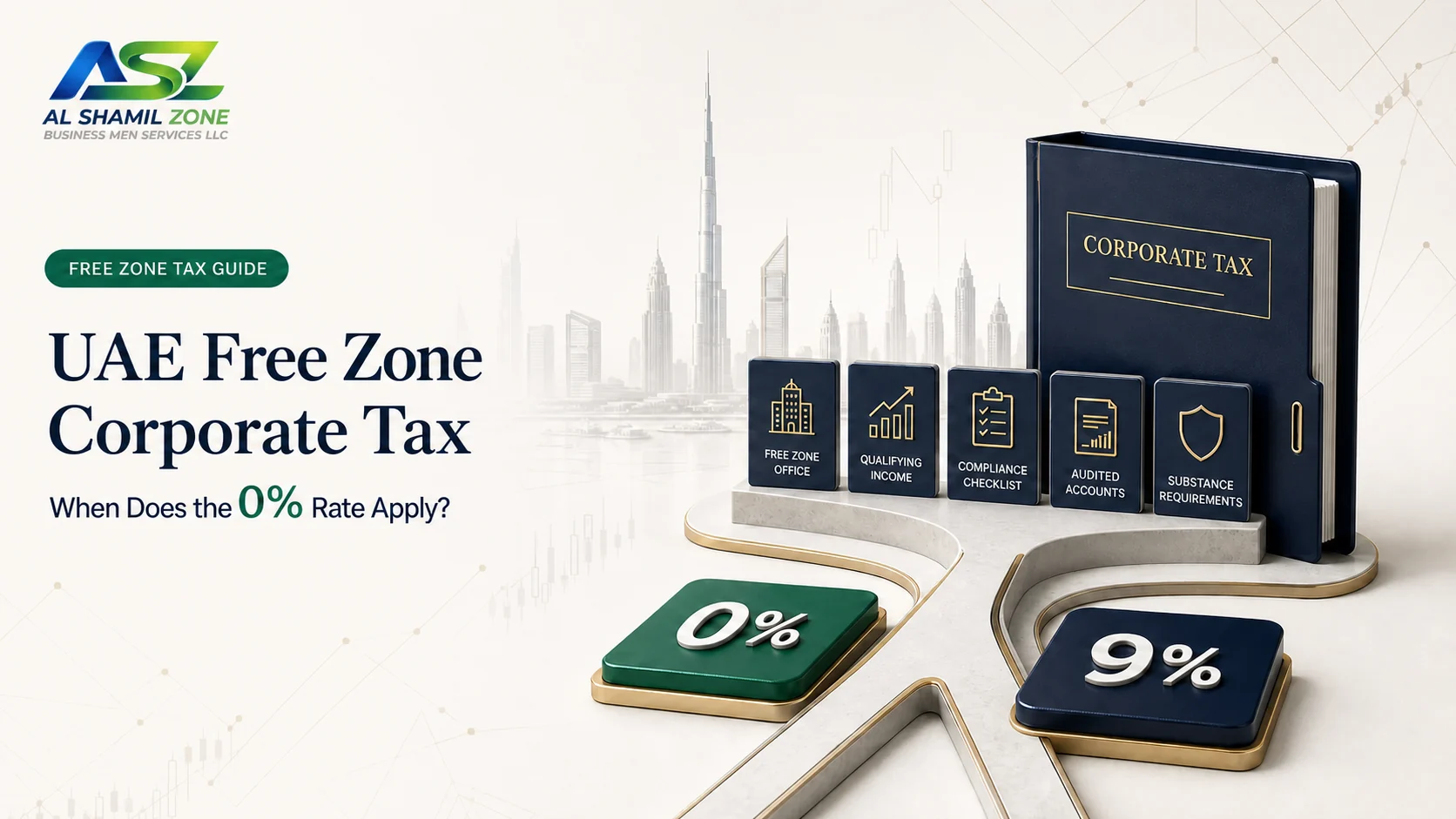
A UAE Free Zone licence does not automatically make every dirham of profit subject to Corporate Tax at 0%. The Free Zone Corporate Tax regime is conditional: the company must qualify as a Qualifying Free Zone Person (QFZP), maintain the required conditions and correctly identify which income is Qualifying Income.
This distinction matters when choosing a Free Zone, planning transactions or preparing a Corporate Tax return. A company can hold a valid Free Zone licence and still have income taxed at 9%, or lose access to the QFZP regime if it does not satisfy the applicable requirements.
What does the Free Zone 0% Corporate Tax rate mean?
The regime allows an eligible QFZP to apply:
- 0% Corporate Tax to its Qualifying Income; and
- 9% Corporate Tax to taxable income that is not Qualifying Income.
It is therefore not a blanket exemption from Corporate Tax. The classification of the company, its activities, customers, transaction flows, premises and income all matter.
The Federal Tax Authority (FTA) also makes clear that Free Zone Persons remain within the UAE Corporate Tax system. They must register for Corporate Tax and comply with filing and record-keeping obligations even when their Qualifying Income is taxed at 0%.
Who can be a Qualifying Free Zone Person?
A Free Zone Person is generally a juridical person incorporated, established or registered in a Free Zone, including certain branches. Being a Free Zone Person is only the starting point. To retain QFZP status, the person must satisfy all applicable conditions.
At a practical level, the principal requirements include:
- maintaining adequate substance in a Free Zone or Designated Zone, as applicable;
- deriving Qualifying Income;
- not electing to be subject to the standard Corporate Tax rules;
- complying with the arm's-length principle and applicable transfer-pricing requirements;
- maintaining the required transfer-pricing documentation;
- preparing audited financial statements where required for the regime; and
- meeting the de minimis requirement for non-qualifying revenue.
These requirements must be considered together. Satisfying only one or two of them is not enough.
What is adequate substance?
A QFZP must conduct its core income-generating activities in the relevant Free Zone or Designated Zone. It should have adequate assets, qualified full-time employees and operating expenditure in relation to the activities it performs and the income it earns.
There is no universal substance checklist that suits every business. A holding company, a distribution operation and a manufacturing business naturally require different resources. The assessment must be proportionate to the nature and scale of the activity.
Core income-generating activities may be outsourced in permitted circumstances, but the QFZP must maintain appropriate supervision and meet the conditions in the legislation. A licence with no credible operating presence should not be treated as sufficient evidence of substance.
Which income may be Qualifying Income?
The answer depends on the counterparty, the activity and the rules applicable to the transaction. Broadly, the regime can cover specified income from:
- transactions with other Free Zone Persons where the relevant conditions are satisfied and the counterparty is the beneficial recipient;
- transactions with non-Free Zone Persons arising from recognised Qualifying Activities;
- certain qualifying intellectual-property income calculated under the prescribed approach; and
- other income that remains within the permitted de minimis limit.
A business should never decide that income qualifies merely because an invoice was issued from a Free Zone. The underlying activity, recipient and commercial arrangement must be examined.
Qualifying Activities and Excluded Activities
The Ministry of Finance periodically specifies the activities that may qualify and those that are excluded. Ministerial Decision No. 229 of 2025 replaced the earlier 2023 activity decision and updated aspects of the regime, including qualifying commodity trading and treasury and financing services for related parties.
Depending on the detailed conditions, recognised Qualifying Activities can include areas such as:
- manufacturing and processing of goods or materials;
- holding shares and other securities for investment purposes;
- ownership, management and operation of ships;
- reinsurance and certain regulated fund, wealth or investment-management activities;
- headquarters and treasury or financing services to related parties;
- financing and leasing of aircraft;
- distribution of goods or materials from a Designated Zone, subject to the rules;
- logistics services; and
- activities ancillary to a Qualifying Activity.
Excluded Activities can include specified transactions involving natural persons, banking, insurance activities other than permitted reinsurance, certain finance and leasing activities, ownership or exploitation of immovable property, and intellectual property other than qualifying intellectual property.
These lists contain definitions, exceptions and conditions. A label on a trade licence is not enough to determine the tax outcome.
What is the de minimis requirement?
The de minimis rule provides limited tolerance for non-qualifying revenue. Under the framework described by the Ministry of Finance, non-qualifying revenue must not exceed the lower of:
- 5% of total revenue; or
- AED 5 million.
The calculation has specific inclusions and exclusions. Businesses should map revenue by source rather than applying the percentage casually to total bank receipts.
If the applicable conditions or de minimis requirement are breached, the consequences can extend beyond the individual non-qualifying transaction. This is why revenue classification should be monitored during the tax period, not only when the return is due.
Does selling to Mainland customers prevent the 0% rate?
Not automatically, but Mainland transactions require careful analysis. Income from a non-Free Zone Person generally needs to arise from a recognised Qualifying Activity to fall within the QFZP rules, subject to the exclusions and other conditions.
For example, a company should review:
- what it actually supplies;
- whether the activity is qualifying or excluded;
- where the activity is performed;
- whether a Domestic Permanent Establishment exists;
- whether the customer or recipient has a relevant Free Zone status; and
- whether the income is properly attributed and documented.
Profits attributable to a Domestic Permanent Establishment outside the Free Zone, or a Foreign Permanent Establishment, may be subject to the 9% rate under the applicable rules.
Are audited financial statements required?
Audited financial statements are an important compliance condition for businesses using the QFZP regime. The accounts should support the revenue classifications, permanent-establishment attribution, related-party positions and calculation of taxable income.
Waiting until the Corporate Tax return deadline to organise accounting records creates avoidable risk. A Free Zone business intending to claim 0% should establish its chart of accounts and supporting-document process from the beginning of the tax period.
Transfer pricing still applies
Transactions with related parties and connected persons must follow the arm's-length principle. This applies to domestic and cross-border arrangements, including transactions between Mainland and Free Zone entities within the same group.
Typical areas requiring support include management fees, shareholder or related-party loans, intellectual-property charges, shared employees, central services and intercompany trading margins.
Common misconceptions about Free Zone Corporate Tax
| Misconception | Practical position |
|---|---|
| “A Free Zone licence means the company pays no Corporate Tax.” | Only Qualifying Income of an eligible QFZP can benefit from the 0% rate. |
| “A 0% company does not need Corporate Tax registration.” | Free Zone Persons remain subject to registration and return-filing requirements. |
| “Any Free Zone activity is a Qualifying Activity.” | Tax classifications are determined by the Corporate Tax legislation, not only the licence description. |
| “Invoices to another Free Zone company always qualify.” | The transaction, beneficial recipient and excluded-activity rules must still be assessed. |
| “A flexi-desk automatically proves adequate substance.” | Substance depends on the assets, people, expenditure and core activities appropriate to the business. |
| “Only the non-qualifying sale is affected by a breach.” | Failing a QFZP condition can have wider consequences for the person's tax treatment. |
A practical QFZP readiness checklist
Before relying on the Free Zone 0% rate, confirm that the business can answer “yes” to the following:
- Is the entity legally a Free Zone Person for Corporate Tax purposes?
- Have all revenue streams been mapped by activity and counterparty?
- Are Qualifying and Excluded Activities identified using the latest legislation?
- Is the beneficial-recipient condition documented where relevant?
- Does the business maintain adequate assets, employees and expenditure?
- Are Mainland branches or permanent establishments separately analysed?
- Is non-qualifying revenue monitored against the de minimis limit?
- Are related-party transactions supported at arm's length?
- Are the accounting records ready for audit?
- Has the company registered for Corporate Tax and diarised its return deadline?
Plan the tax position before choosing the structure
Corporate Tax should be considered during company formation, not after the licence is issued. The best structure depends on where customers are located, how contracts will be performed, whether staff and assets will sit inside the Free Zone, and whether the planned income is capable of qualifying.
A Free Zone can still be commercially attractive even when some or all income is taxed at 9%. The right decision should balance tax treatment with licence scope, operating costs, premises, visas, banking, logistics and long-term expansion.
Official references
- FTA Corporate Tax Guide: Free Zone Persons
- FTA Corporate Tax legislation and decisions
- Ministry of Finance: Ministerial Decision No. 229 of 2025
Need help reviewing your Free Zone Corporate Tax position? Call Al Shamil Zone on 800 2794, message us through WhatsApp, or email info@shamilservices.ae.
This article is general information, not tax or legal advice. Corporate Tax treatment depends on the legislation in force, the entity, its activities, counterparties, transaction documents and other facts. Obtain professional advice before filing a return or relying on the QFZP regime.
Ready to get started? Contact Al Shamil Zone by phone at 800 ASZG (2794), via WhatsApp at +971 54 586 6222, or email info@shamilservices.ae.