UAE E-commerce Compliance for Businesses: 2026 Guide
A practical guide to UAE online-business compliance covering licensing, product information, digital contracts, consumer rights, payments, invoices, data and marketing.
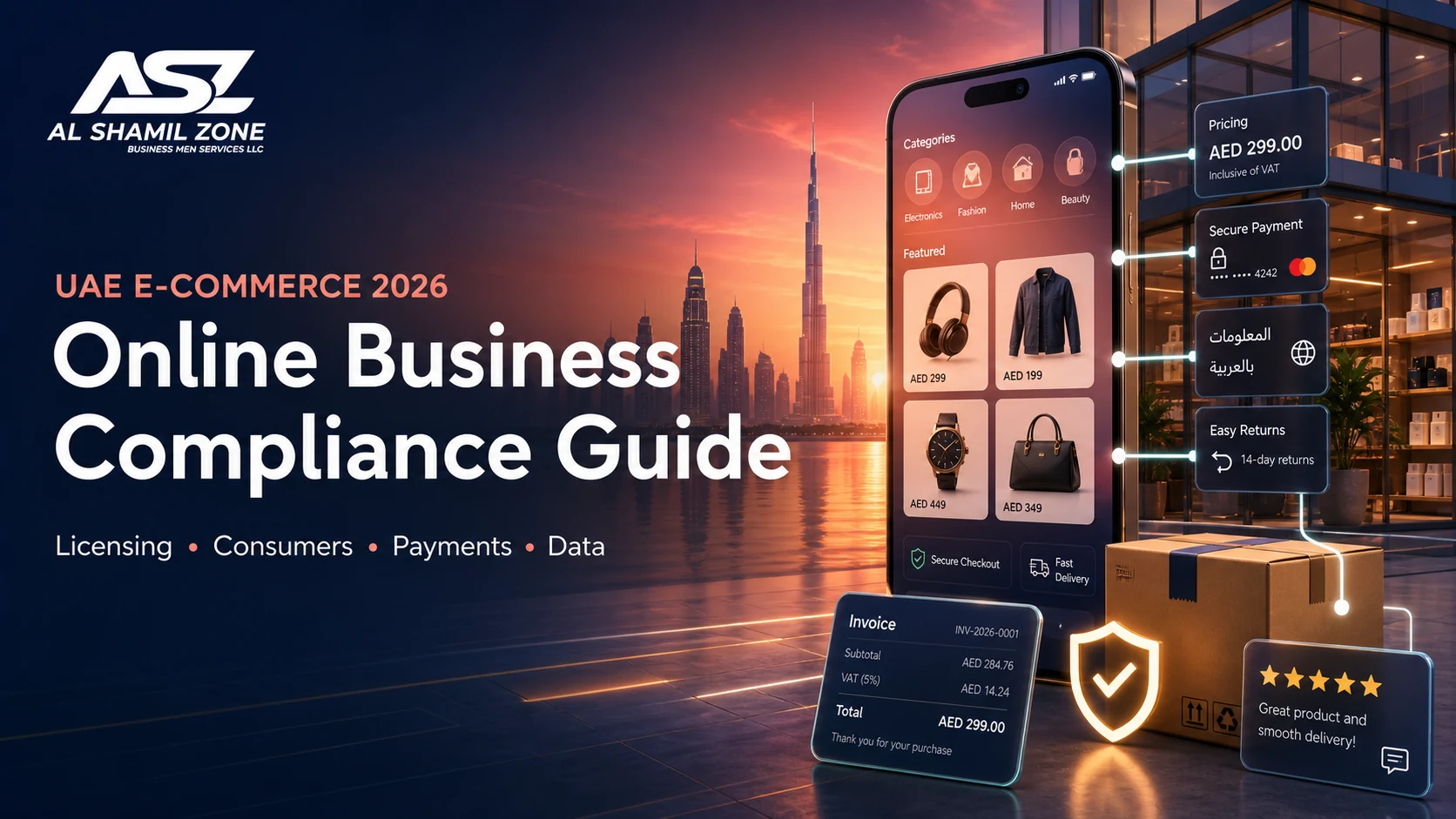
Selling through a website, mobile app, marketplace or social-media account can feel simpler than operating a physical shop, but it does not remove licensing and consumer obligations. UAE online traders must align their commercial activity, product approvals, digital contracts, customer information, payment process, fulfilment, data handling and marketing with the applicable rules.
Federal Decree-Law No. 14 of 2023 concerning Modern Technology-Based Trade provides a dedicated framework for technology-enabled commerce. It works alongside the Consumer Protection Law, its executive regulation, the Personal Data Protection Law, electronic-transactions rules, tax requirements and sector-specific controls.
UAE e-commerce compliance at a glance
| Area | What the business should confirm |
|---|---|
| Trade licence | The legal entity and licence cover the products, services and online sales activity. |
| Product approval | Restricted or regulated goods have the required registrations and permits. |
| Seller disclosure | Customers can identify the trader, address and licensing authority. |
| Product information | Descriptions, specifications, price, delivery and warranty information are accurate and clear. |
| Digital contract | The checkout records offer, acceptance, terms, costs and order details. |
| Consumer rights | Returns, defects, complaints and refunds are handled under applicable law. |
| Payments | The gateway and checkout are secure, transparent and properly integrated. |
| Data | Collection, marketing and sharing follow privacy requirements. |
| Invoices and tax | Digital invoices and VAT treatment are correct for the transaction. |
What counts as technology-based trade?
The 2023 law defines modern technology-based trade broadly. It includes buying and selling goods, services and related data through websites, electronic platforms, smart applications, digital marketplaces and social-media platforms. Physical goods ordered online and digital products or subscriptions can both fall within the framework.
The law also reaches connected functions to the extent related to e-commerce, including technological platforms, logistics and digital payment gateways. A seller therefore needs to review the complete customer journey rather than focusing only on the webpage where the order is placed.
Step 1: choose the correct legal and licensing route
A business selling online on the UAE mainland requires a commercial licence covering the relevant commercial and e-commerce activities from the competent emirate authority. Some authorities offer specific individual online-business routes, while others add an e-commerce activity to a standard licence.
Free zones offer e-commerce and trading licences, but the establishment location does not automatically settle where and how goods can be sold. A free-zone company selling directly into the mainland may need an approved distributor, customs and logistics arrangements, dual licensing or other authority-specific structures.
The UAE Government portal also states that e-commerce licences require the relevant TDRA no-objection process for practising digital activity. Applicants should confirm the current procedure through the chosen licensing authority.
Step 2: match every product to the licensed activity
“E-commerce” describes the sales channel; it does not replace the underlying commercial activity. A store selling cosmetics, electronics, food, medical products or professional services may need different activities and external approvals.
The catalogue should be reviewed before launch and whenever new categories are added. Marketplaces can make listing easy, but the seller remains responsible for ensuring that products are permitted, authentic, safe, correctly labelled and supported by any required registration.
Step 3: identify the digital trader clearly
Online customers should know who they are contracting with. UAE consumer rules require locally registered e-commerce providers to make information available about matters including their name, legal status, address and licensing authority.
Practical disclosure normally belongs in the website footer, terms, checkout and invoice. A social-media store should not rely only on a profile nickname or direct messages. If the brand differs from the licensed entity name, the relationship should be explained.
Step 4: publish accurate Arabic product and contract information
Federal consumer-protection rules require sufficient information in Arabic about the product or service, specifications, contract terms, payment and warranty. Other languages may be used alongside Arabic.
Information should be specific enough to support an informed decision. Depending on the item, this may include dimensions, materials, quantity, compatibility, origin, expiry, safety information, subscription period or service limitations. Photographs should not create a materially misleading impression.
Automated translations should be reviewed. Incorrect Arabic descriptions, measurements or warranty statements can create complaints and regulatory exposure.
Step 5: make pricing and charges transparent
The customer should see the actual price and relevant costs before confirming the order. Delivery, installation, service, subscription, customs or other charges should not appear unexpectedly after acceptance.
Promotions must be genuine and clearly qualified. A crossed-out “original price” should have a defensible basis. Limited-time offers, coupon restrictions, minimum spends and auto-renewals should be explained where the customer can see them.
VAT presentation and invoicing should align with the business's registration status and Federal Tax Authority requirements. A payment screen should not label an amount as VAT if the seller is not entitled to charge it.
Step 6: create an enforceable digital contract
The technology-based trade law recognises digital contracts and electronic acceptance. The business should preserve evidence showing the product, price, terms, delivery promise, customer's acceptance and order confirmation.
Terms should cover the identity of the seller, eligibility, ordering, payment, fulfilment, cancellation, returns, warranties, subscriptions, intellectual property, liability and dispute handling. Terms that attempt to remove mandatory consumer rights can be invalid.
A browse-wrap footer link may not provide strong evidence for unusual or important provisions. The checkout should present material terms clearly and capture affirmative acceptance where appropriate.
Step 7: issue a clear digital invoice
Official UAE e-commerce guidance states that online traders should provide a digital invoice for every transaction. Consumer-protection legislation also requires dated invoice information, including the supplier's trade name, address, goods or service, price and quantity, together with other prescribed details.
The invoice should be retrievable by the customer and linked to the actual order. It should correctly reflect discounts, VAT, delivery and refunds. Numbering, storage and accounting treatment should support tax and audit records.
Step 8: design fair cancellation, return and refund procedures
Return rights depend on the law, product, defect, seller's terms and circumstances. A store should distinguish between defective or incorrectly described goods, customer change of mind, non-returnable categories and cancelled services.
The policy should explain the request method, period, condition, evidence, collection or delivery responsibility, refund method and expected timing. It should not impose a blanket “no refunds” statement where mandatory rights apply.
Customer-support teams need authority and scripts that match the published policy. A clear policy is ineffective if each complaint receives a different answer.
Step 9: manage delivery and fulfilment promises
The consumer has a right to receive goods or services according to announced specifications, timing, value and stated logistics cost. Stock indicators and delivery estimates should therefore reflect reasonable operational capability.
The seller should define when risk and delivery occur, what happens after failed delivery, how damaged packages are handled and which party manages claims. Outsourcing fulfilment does not remove the seller's relationship with the customer.
Step 10: use secure and authorised payments
A trader should use reputable payment providers and secure checkout practices. Card information should not be collected through informal messages or stored unnecessarily. Strong authentication, access control, encryption, monitoring and fraud procedures reduce risk.
The checkout should identify currency, amount, recurring nature and refund route. Buy-now-pay-later, stored-value, wallet or financial-service arrangements may introduce additional regulatory considerations.
Step 11: protect customer data
Customer names, addresses, phone numbers, device identifiers, purchase history and support messages are personal data. Collection and use should comply with the applicable data-protection regime.
The business should publish an accurate privacy notice, collect only necessary information, control employee access, secure accounts, assess vendors, define retention and prepare for breaches. Sharing data with couriers, analytics tools, cloud providers and overseas support teams should be mapped.
Consumer-protection rules also protect consumer privacy and restrict use for promotional or marketing purposes. A purchase should not automatically become unlimited permission for advertising.
Step 12: respect marketing choices
The technology-based trade law recognises the consumer's choice to receive or refuse promotional and marketing campaigns through communications, email or social media. Marketing consent and opt-out preferences should be recorded and honoured across systems.
Influencer and affiliate promotions should be truthful and clearly identifiable. Advertisers should confirm current UAE Media Council and platform requirements, including permits where applicable. Reviews should not be fabricated, selectively manipulated or presented misleadingly.
Step 13: provide ratings, complaints and dispute channels
The 2023 law gives consumers a transparent field to evaluate their experience with the digital trader, goods, services, payment gateways and logistics. A business should design reviews so they are genuine, moderated fairly and protected from misuse.
Complaint channels should be easy to find. Record the complaint, order, evidence, response, resolution and recurring root cause. Customers may also approach the Ministry of Economy and Tourism or the competent local consumer-protection authority.
Marketplaces, social commerce and dropshipping
Selling through a third-party marketplace does not automatically transfer every obligation to the platform. The merchant should understand which party is seller of record, issues invoices, imports goods, collects payment, handles VAT and resolves returns.
Social-media selling still requires the appropriate licence and customer disclosures. Dropshipping adds supplier, product-quality, origin, delivery and refund risks. The UAE seller should not promise performance it cannot control or sell products whose compliance it has not verified.
Common e-commerce compliance mistakes
- Obtaining an e-commerce licence without the underlying trading activity.
- Selling restricted products before approvals are complete.
- Hiding the licensed entity behind a social-media brand.
- Publishing only English consumer information.
- Adding delivery or subscription charges late in checkout.
- Using a blanket no-return or no-refund statement.
- Failing to issue a proper digital invoice.
- Adding every customer to marketing lists automatically.
- Ignoring mainland distribution rules for a free-zone entity.
- Assuming the marketplace handles all tax and consumer obligations.
A practical launch checklist
- Select the entity, jurisdiction and licensed activities.
- Confirm TDRA and product-specific approvals.
- Review mainland, import, customs and logistics arrangements.
- Publish legal entity and licence details.
- Prepare accurate Arabic and English product information.
- Display prices, taxes, delivery and recurring charges clearly.
- Implement valid digital terms and acceptance records.
- Configure digital invoices and accounting records.
- Publish lawful cancellation, return, warranty and refund procedures.
- Secure payments, accounts and customer information.
- Implement privacy notices and marketing choices.
- Set complaint, review and product-recall procedures.
- Test the complete customer journey before launch.
- Review compliance whenever products, markets or platforms change.
Official references
- Federal Decree-Law No. 14 of 2023 on Modern Technology-Based Trade
- Official UAE Government e-commerce guidance
- Federal Law No. 15 of 2020 on Consumer Protection
- Cabinet Resolution No. 66 of 2023: Consumer Protection Executive Regulation
- Ministry of Economy and Tourism: Consumer protection
- Federal Electronic Transactions and Trust Services Law
Planning an online business in the UAE? Call Al Shamil Zone on 800 2794, contact us through WhatsApp, or email info@shamilservices.ae.
This article provides general information and is not legal, tax, consumer-protection or cybersecurity advice. Confirm current requirements with the relevant authority and advisers before launch.
Ready to get started? Contact Al Shamil Zone by phone at 800 ASZG (2794), via WhatsApp at +971 54 586 6222, or email info@shamilservices.ae.