How to Close a Company in the UAE
A practical guide to UAE company liquidation, employee and visa clearances, licence cancellation, VAT and Corporate Tax deregistration and final closure.
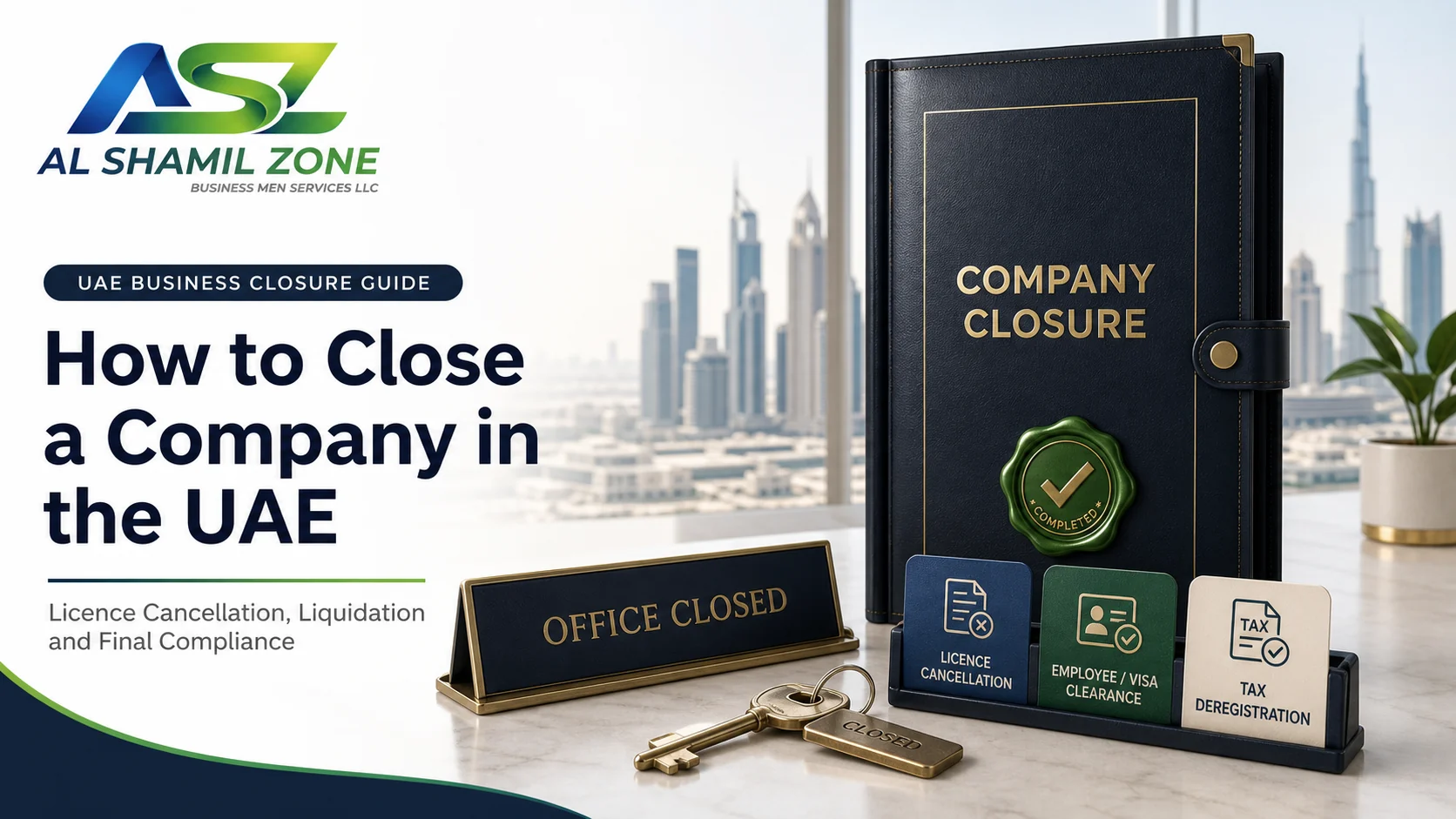
Stopping sales or allowing a UAE trade licence to expire does not close a company. A proper closure normally requires shareholder approval, settlement of employees and creditors, cancellation of permits and visas, tax deregistration, authority clearances and a final licence-cancellation or deregistration certificate.
The exact route depends on the emirate, licensing authority, free zone, legal form, activities and whether the company is solvent. A sole establishment may follow a simpler cancellation process, while an LLC or another incorporated company may require a licensed liquidator and formal liquidation notices.
Why formal company closure matters
An expired licence, empty office or inactive bank account does not remove the company's legal and compliance obligations. Without formal closure, the business can continue to accumulate:
- licence renewal and late penalties;
- lease, utility and service charges;
- employee and immigration liabilities;
- VAT and Corporate Tax filing obligations;
- bank charges and guarantees;
- regulatory or beneficial-owner compliance requirements; and
- claims from customers, suppliers, landlords or other creditors.
The objective is not merely to receive a cancelled licence. It is to leave a documented trail showing that the company, its people, contracts, assets, debts and government registrations were dealt with correctly.
First decide: closure, sale, dormancy or restructuring?
Before shareholders vote to liquidate, confirm that closure is the right commercial outcome. Alternatives may include:
- selling the shares or business assets;
- merging with another company;
- changing the legal form or jurisdiction;
- removing activities, partners or branches;
- placing the company into an authority-approved dormant status where available; or
- renewing temporarily while a transaction is completed.
These alternatives have different legal and tax consequences. Do not transfer contracts, assets or employees before checking whether approvals, creditor consent or a transfer-of-business analysis is required.
Licence cancellation versus liquidation
Licence cancellation is the authority procedure that ends the commercial licence or registration. Liquidation is the wider legal process of winding up a company: appointing a liquidator where required, collecting assets, settling liabilities and distributing any remaining balance.
The UAE Government notes that, for mainland establishments and branches, the cancellation request may be submitted by the concerned party. For companies requiring liquidation, the liquidator generally submits the final application.
| Structure or situation | Typical closure consideration |
|---|---|
| Sole establishment | May use a direct cancellation route after employee, immigration and authority clearances |
| Civil company or partnership | May require a notarised termination or dissolution document and partner approvals |
| LLC or incorporated company | Commonly requires a shareholder resolution, liquidator and formal liquidation process |
| Local or foreign branch | Requires a parent-company decision and may involve Ministry or home-jurisdiction documents |
| Free-zone company | Follows the specific free-zone deregistration, clearance and liquidation procedure |
| Insolvent company | May require specialist insolvency advice rather than an ordinary voluntary closure |
The table is only a planning guide. Obtain the exact checklist from the current licensing authority before preparing resolutions or cancelling operational facilities.
Step 1: Map the company and all linked registrations
Create a closure register containing:
- trade licence, commercial registration and legal form;
- memorandum, articles and shareholder details;
- branches, subsidiaries and establishment cards;
- regulated activity permits and external approvals;
- MOHRE labour file and employee work permits;
- investor, partner, employee and dependant visas;
- VAT, Corporate Tax and Excise Tax registrations;
- customs, municipality and chamber registrations;
- leases, utilities, telecoms and insurance;
- bank accounts, loans, guarantees and merchant facilities; and
- customer, supplier and distributor agreements.
This prevents a hidden branch, permit, tax registration or guarantee from remaining active after the main licence is cancelled.
Step 2: Review solvency, contracts and financial position
Prepare current management accounts and a realistic closure budget. Identify cash, receivables, inventory, fixed assets, deposits, employee dues, taxes, loans, leases, warranties, customer advances and disputed claims.
Questions to answer include:
- Can the company pay all debts as they fall due?
- Are shareholders expected to provide closure funding?
- Which contracts require notice or early-termination payment?
- Can customer projects be completed, refunded or assigned?
- Are personal or bank guarantees still outstanding?
- Are any lawsuits, bounced cheques or regulatory investigations pending?
If the company cannot pay its debts, stop and obtain insolvency advice. A standard voluntary liquidation should not be used to bypass creditor rights.
Step 3: Pass the required shareholder resolution
The owners normally approve dissolution and liquidation through a resolution prepared in the form required by the authority and constitutional documents. It may need notarisation, attestation or legalisation.
The resolution commonly records:
- the decision and reason to dissolve the company;
- the effective date;
- appointment and powers of the liquidator;
- authorised signatories for the closure;
- treatment of branches and licences; and
- approval to settle liabilities and distribute any surplus.
Foreign shareholder or parent-company documents may require board approval, notarisation, legalisation and Arabic translation.
Step 4: Appoint a liquidator where required
The licensing authority may require a UAE-licensed auditor or liquidator to accept the appointment formally. The liquidator typically takes responsibility for the liquidation file, creditor process and final report.
Confirm the scope and fees in writing, including:
- initial liquidation documentation;
- newspaper or public notices;
- creditor claim management;
- asset and liability verification;
- tax and employee coordination;
- final liquidation report; and
- authority submission and follow-up.
Do not assume every legal form needs the same liquidator process or notice period.
Step 5: Obtain initial liquidation approval and publish notices
Where the authority requires formal liquidation, the resolution, liquidator acceptance and supporting documents are submitted for initial approval. A creditor notice may then be published for the prescribed period.
The UAE Government's mainland guidance shows that formalities differ by emirate and legal form. Some procedures use newspaper advertisements or other notices before final cancellation. The exact language, publication channel and waiting period must come from the relevant authority or liquidator.
Keep the complete publication evidence and address every creditor claim before signing the final declaration.
Step 6: Settle employees and cancel work permits
Plan employee exits early and comply with contractual notice, applicable labour law and company policy. Calculate salary, unused leave, end-of-service benefits, notice pay, expenses, commissions and any repatriation obligations.
MOHRE's work-permit cancellation service requires the establishment to confirm that the worker's rights, dues and entitlements have been satisfied. Depending on the case, employee acknowledgement or other evidence can be required.
A practical employee-closure file should contain:
- termination notice and final settlement calculation;
- proof of payment;
- signed acknowledgement where applicable;
- work-permit and employment-contract cancellation;
- residence-visa cancellation or transfer;
- medical-insurance end date;
- return of company property; and
- employment certificate and record retention.
Coordinate work-permit and residence cancellation so employees have accurate information about their status and permitted next steps.
Step 7: Cancel investor, partner and dependant visas
Investor and partner residence visas, employee visas and sponsored dependant visas must be identified and handled through the appropriate immigration authority. The order matters: a sponsor may need to cancel or transfer dependants before cancelling their own residence.
Also cancel or close the company's immigration establishment card and any authority portal files when eligible. Keep cancellation confirmations with the final company record.
Step 8: Close contracts, premises and external permits
Obtain the clearances required for the company's activity and jurisdiction. These may involve:
- landlord or free-zone lease clearance;
- electricity, water, cooling and telecom accounts;
- municipality, civil defence and environmental permits;
- customs code and importer registrations;
- healthcare, education, transport or professional regulators;
- chamber membership;
- post boxes, domains and software subscriptions; and
- payment gateways and merchant terminals.
Photograph the premises, document handover and retain evidence of deposits, final meter readings and returned access cards.
Step 9: Collect receivables, settle creditors and dispose of assets
Send final statements to customers, collect receivables and resolve disputes. Pay suppliers, employees, authorities, lenders and other creditors in the proper order.
Asset sales or distributions can create VAT, Corporate Tax and accounting consequences. Record the recipient, value, consideration and approval for every transfer. Protect personal data and confidential records when selling or disposing of computers and files.
Do not distribute remaining cash or assets to shareholders until creditors, tax obligations and liquidation costs have been properly addressed.
Step 10: Complete VAT deregistration
Trade-licence cancellation does not automatically deregister VAT. If the company is VAT-registered, assess the mandatory deregistration trigger, apply through EmaraTax within the applicable deadline and prepare the final return.
The FTA's current VAT service information states that mandatory applications must be submitted within 20 business days from the date the deregistration obligation begins. The final return and payable tax must be dealt with according to the effective deregistration date.
Review retained stock, fixed assets, customer deposits, bad debts, imports and input-tax adjustments before completing the final VAT position.
Step 11: Complete Corporate Tax deregistration
A company with a Corporate Tax Registration Number must submit a separate Corporate Tax deregistration request through EmaraTax when its business ceases through dissolution, liquidation or otherwise.
FTA Decision No. 6 of 2023 provides a three-month application period for a juridical person from the date the entity ceases to exist, the business ceases, or dissolution or liquidation occurs.
Under the Corporate Tax Law, deregistration is not completed until due Corporate Tax and administrative penalties are paid and all required returns—including the return up to the cessation date—are filed.
The current FTA service card lists an estimated 30-business-day review period for a completed application, with additional time possible if more evidence is required.
Step 12: Close bank accounts and release guarantees
Do not close the bank account at the start of liquidation. The company may still need to receive receivables, refund customers, pay employees and taxes, or receive authority and landlord refunds.
Before final bank closure:
- cancel unused cards, cheque books and online users;
- settle loans, overdrafts and merchant chargebacks;
- release bank guarantees and security deposits;
- download statements and payment evidence;
- confirm how tax refunds or final receipts will be handled; and
- obtain written closure confirmation.
Personal guarantees do not necessarily end when the licence is cancelled. Obtain an express release where applicable.
Step 13: Submit the final liquidation report and cancel the licence
After the notice period and clearances are complete, the liquidator prepares the final report or declaration required by the authority. The final submission commonly includes the liquidation documents, creditor evidence, employee and immigration clearances, tax status and other authority approvals.
When approved, obtain the final licence cancellation, deregistration or termination certificate. Check that the commercial register and linked branches reflect the closure correctly.
Mainland versus free-zone closure
Mainland companies close through the relevant emirate's economic department and linked federal or local authorities. Documentation differs between establishments, civil companies, LLCs and branches.
Free-zone companies follow the selected free zone's own termination process. The UAE Government summarises the common components as a shareholder resolution, cancellation of employee and investor visas, settlement of obligations, FTA deregistration where applicable, licence cancellation or liquidation application, required clearances and a final deregistration certificate.
Do not transfer a checklist from one free zone to another. Request the current procedure, forms, fees and expected timeline directly from the authority.
What if the licence has already expired?
An expired licence usually still needs formal cancellation. The authority may require outstanding renewals, fines or status corrections before accepting closure documents. Tax and employee obligations also continue independently.
Act quickly: delaying can increase penalties, make signatories or employees unavailable and cause records to become harder to obtain.
Common closure mistakes
- Letting the licence expire instead of formally cancelling it.
- Closing the bank account before paying employees and taxes.
- Assuming licence cancellation also cancels VAT and Corporate Tax.
- Using the wrong procedure for the legal form.
- Ignoring branches, external permits or customs registrations.
- Paying shareholders before creditors and closure costs.
- Missing employee dues or cancelling visas in the wrong order.
- Transferring assets without documenting value and tax treatment.
- Failing to release personal and bank guarantees.
- Discarding records after receiving the cancellation certificate.
UAE company-closure checklist
- Confirm closure is preferable to sale or restructuring.
- Obtain the authority checklist for the legal form.
- Map licences, branches, employees, visas, taxes and permits.
- Review solvency and prepare a funded closure plan.
- Pass and authenticate the shareholder resolution.
- Appoint and register a liquidator where required.
- Publish creditor notices and settle claims.
- Pay employee entitlements and cancel permits and visas.
- Close leases, utilities, contracts and external approvals.
- Collect receivables and settle creditors.
- Document asset sales and distributions.
- Deregister VAT and complete the final return.
- Deregister Corporate Tax and file all required returns.
- Release guarantees and close bank facilities.
- Submit the final liquidation report.
- Obtain and verify the final cancellation certificate.
- Securely retain the statutory, accounting, tax and employee records.
Official references
- UAE Government: Closing a business on the mainland
- UAE Government: Closing a business in a free zone
- MOHRE: Cancellation of work permits and employment contracts
- Federal Tax Authority: VAT Deregistration
- Federal Tax Authority: Corporate Tax Deregistration
- FTA Decision No. 6 of 2023: Corporate Tax deregistration timeline
Need support closing a UAE company correctly? Call Al Shamil Zone on 800 2794, contact us through WhatsApp, or email info@shamilservices.ae.
This article provides general information and is not legal, insolvency, employment or tax advice. Closure requirements depend on the authority, legal form, solvency, activities and current law. Obtain professional advice before taking irreversible steps.
Ready to get started? Contact Al Shamil Zone by phone at 800 ASZG (2794), via WhatsApp at +971 54 586 6222, or email info@shamilservices.ae.