Dubai Virtual Asset Business Setup and VARA Licensing: 2026 Guide
Understand Dubai VARA licensing, the eight regulated virtual-asset activities, the two-stage application, governance, AML, technology and launch requirements.
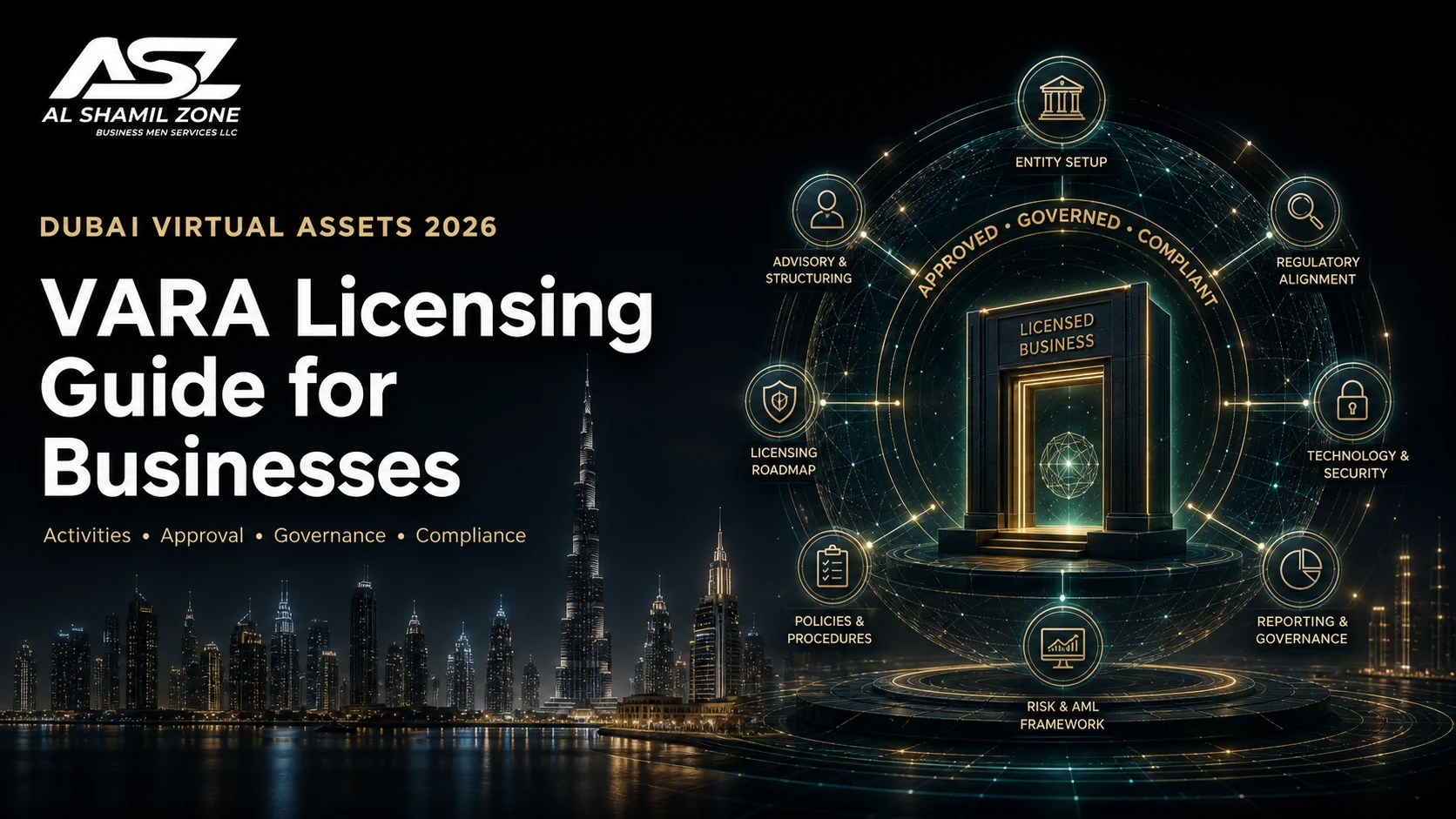
Dubai has built a dedicated regulatory framework for businesses providing virtual-asset services. The Virtual Assets Regulatory Authority, known as VARA, regulates virtual assets and related activities conducted in or from the Emirate of Dubai, including Dubai mainland and its free zones, except the Dubai International Financial Centre.
A normal commercial licence is not enough to operate a regulated virtual-asset service. A business must determine whether its proposed model falls within a VARA activity, establish through the appropriate Dubai licensing authority and complete the required VARA authorisation before commencing operations or serving clients.
VARA licensing at a glance
| Question | Practical answer |
|---|---|
| Where does VARA apply? | Across Dubai mainland and Dubai free zones, except DIFC. |
| Who needs authorisation? | A firm carrying on a regulated virtual-asset activity in or from Dubai. |
| Where is the application submitted? | Through Dubai Economy and Tourism for mainland firms or a participating Dubai free-zone authority. |
| What is stage one? | Approval to Incorporate, enabling entity establishment and operational preparation subject to its conditions. |
| What is stage two? | The application and assessment for the full VASP licence. |
| Can an IPA holder serve clients? | No. VARA states that an in-principle approval does not permit operations or client servicing. |
| Can multiple activities be licensed? | Potentially, but each activity's requirements must be satisfied; custody has special separation requirements. |
What is a virtual asset?
Virtual assets are digital representations of value that can be digitally traded, transferred or used for payment or investment purposes, subject to the legal definitions and exclusions in the applicable framework. The analysis focuses on substance rather than branding. Calling a product a “digital point,” “utility token” or “technology service” does not remove it from regulation if its functions bring it within scope.
Virtual assets are not identical to fiat currency, securities or every digital record. Products involving payments, securities, funds, stored value or financial services may involve the Central Bank, capital-markets authority, DIFC regulators or other bodies. Regulatory perimeter analysis should happen before the entity, technology and customer journey are finalised.
Where does VARA have jurisdiction?
VARA is the authority for virtual-asset activities across the Emirate of Dubai, including mainland and Dubai free zones, other than DIFC. A business established in DIFC must review the DIFC and Dubai Financial Services Authority framework instead.
Outside Dubai, other federal, emirate and financial-free-zone regulators may apply. A licence issued in one jurisdiction should not be assumed to authorise solicitation, onboarding or activity everywhere else. Cross-border services may also trigger rules in the customer's country.
The eight regulated activity categories
VARA identifies eight current categories. A business must map every feature, revenue stream and customer relationship to the official definitions.
1. Advisory Services
This concerns personal recommendations relating to virtual-asset actions or transactions. The dividing line between general education, research and a regulated personal recommendation should be analysed carefully, including how user information shapes the output.
2. Broker-Dealer Services
This category can include arranging orders, facilitating transactions, dealing and distribution functions described in the rulebook. Platforms and intermediaries should map order flow, counterparties, execution, principal exposure and customer assets.
3. Custody Services
Custody involves safeguarding virtual assets or instruments that provide control over them. VARA states that custody is the regulated activity that must be fully segregated into a separate legal entity and separately licensed. Wallet architecture, key management, access controls and asset segregation are central.
4. Exchange Services
Exchange services cover specified exchange and order-book activity involving virtual assets or fiat. Market design, admission standards, surveillance, liquidity, execution, conflicts and technology resilience require detailed preparation.
5. Lending and Borrowing Services
This category addresses virtual-asset lending and borrowing arrangements. Firms must understand collateral, valuation, liquidation, counterparty, liquidity and customer-disclosure risks rather than treating the product as ordinary software.
6. VA Management and Investment Services
This involves managing or investing virtual assets on behalf of clients under the rulebook definition. Suitability, mandate controls, valuation, custody and conflicts need to align with the service model.
7. VA Transfer and Settlement Services
This category covers transmitting or transferring virtual assets between entities or wallets as defined by VARA. Operational controls, beneficiary information, financial-crime compliance and settlement finality are important.
8. VA Issuance – Category 1
Certain virtual-asset issuance falls within the licensing framework. Other issuance may follow different approval requirements under the Virtual Asset Issuance Rulebook. Token design, rights, backing, distribution and whitepaper disclosures should be analysed before marketing or development commitments are made.
Activities outside the full VASP categories
Proprietary trading in virtual assets can require a no-objection certificate and, above specified volumes, registration. VARA also describes an approval process for Category 2 virtual-asset issuance. These paths should not be confused with an unrestricted exemption.
Technology providers should examine what they actually do. Distributed-ledger infrastructure, wallet technology or software may be outside a licensed activity in one configuration and inside it in another where the provider controls, arranges, executes, safeguards, transfers or recommends.
The two-stage VARA application process
Stage 1: Approval to Incorporate
A new applicant starts through DET or the relevant Dubai free-zone authority. The application identifies ownership, proposed activities, business model, governance and other required information. VARA's Approval to Incorporate allows the entity to be established and operational setup to begin under the applicable conditions.
This stage is not a full operating licence. The company should avoid public claims that suggest it is fully licensed and should not conduct regulated services merely because incorporation has occurred.
Stage 2: VASP licence
The full assessment requires detailed evidence that the firm can meet the regulations, compulsory rulebooks and each activity-specific rulebook. VARA may seek explanations, interviews, demonstrations, independent reports, policy revisions and proof of operational readiness.
VARA may issue an in-principle approval while final conditions are completed. Its public-register guidance is explicit that an IPA holder must not initiate operations, conduct virtual-asset activities or service clients until the full VASP licence is granted.
What should an application package demonstrate?
The exact documentation depends on activity and risk, but a credible application generally needs an internally consistent package covering:
- Legal entity, ownership and group structure.
- Controllers, beneficial owners, directors and senior management.
- Detailed business plan, markets, customers and financial forecasts.
- End-to-end product and transaction flows.
- Governance, committees, delegated authorities and conflicts.
- Compliance, AML/CFT, sanctions and suspicious-reporting arrangements.
- Risk management and capital or prudential planning.
- Technology architecture, cybersecurity and operational resilience.
- Custody, wallet, key-management and client-asset controls where relevant.
- Market conduct, disclosures, complaints and customer classification.
- Outsourcing, vendors and material service providers.
- Business continuity, incident response and wind-down planning.
The documents must describe the same business. A polished policy copied from a different operating model can create more questions when it conflicts with the product design, staffing plan or system permissions.
Compulsory and activity-specific rulebooks
A licensed VASP must comply with VARA's regulations and rulebooks. The framework includes compulsory rulebooks addressing matters such as company governance, compliance and risk management, technology and information, and market conduct. Activity rulebooks add requirements for each service.
Version control is important. VARA introduced Version 2.0 activity rulebooks in 2025 and has continued publishing revisions. Application teams should record which current version each policy and control is designed to satisfy.
Governance and fit-and-proper readiness
Virtual-asset regulation expects a real organisation, not a nominal licence shell. Proposed controllers and leaders should be able to demonstrate competence, integrity, time commitment and understanding of the business and its risks.
Governance should define who approves new products, tokens, markets, vendors and material system changes. Conflicts, related-party arrangements and group dependencies should be transparent. Locally accountable personnel need sufficient authority rather than acting only as messengers for an overseas group.
AML and sanctions controls
VASP applicants operate within the UAE's AML, terrorist-financing and proliferation-financing framework. A risk assessment should address customer types, geographies, products, delivery channels, wallet exposure and transaction patterns.
Controls may include customer and beneficial-owner due diligence, wallet and transaction monitoring, sanctions screening, travel-rule processes where applicable, source-of-funds review, escalation and goAML reporting. The system, policy and trained staff should work together.
Technology and information security
Technology is part of the regulated service. The applicant should document architecture, environments, data flows, access, encryption, secure development, vulnerability management, monitoring, incident response, backups and recovery.
Smart contracts, wallets, custody components and outsourced infrastructure require specific review. Material outsourcing does not transfer regulatory responsibility. The business should retain oversight, access rights, exit planning and operational resilience.
Marketing before and after licensing
Virtual-asset promotions in Dubai are regulated. Statements should be fair, clear and not misleading, and required disclosures should be used. Firms should not present an application, ATI or IPA as a full licence.
Customers can check the official VARA public register for the licence type, permitted activities and status. A licensed firm should ensure its website and communications accurately describe only the services it is authorised to provide.
Common setup mistakes
- Forming a generic technology company before mapping regulated activities.
- Assuming a free-zone commercial licence replaces VARA authorisation.
- Beginning client onboarding after an ATI or IPA.
- Using one entity for custody and other activities without considering separation.
- Underestimating capital, staffing and technology requirements.
- Submitting policies that do not match the actual product.
- Ignoring overseas regulatory exposure.
- Marketing before the required approval is in place.
- Failing to check current rulebook versions.
- Using an unlicensed provider without checking the public register.
A practical application-readiness checklist
- Define the product, customers, transaction flow and revenue model.
- Map every feature against VARA's activity definitions.
- Confirm Dubai, DIFC and cross-border regulatory boundaries.
- Select mainland or an appropriate Dubai free-zone route.
- Design the legal and custody entity structure.
- Identify controllers, beneficial owners and qualified leadership.
- Prepare financial, capital and staffing plans.
- Build governance, compliance, AML and risk frameworks.
- Document technology, security, outsourcing and resilience.
- Prepare the ATI submission through the licensing authority.
- Complete operational setup without conducting regulated activity.
- Submit and support the full VASP licence assessment.
- Satisfy conditions and verify full licence status before launch.
- Maintain ongoing reporting, supervision and rulebook compliance.
Official references
- Virtual Assets Regulatory Authority
- VARA licence applications
- VARA activity and other rulebooks
- VARA Schedule 1 activity definitions
- VARA public register
- VARA Version 2.0 activity-rulebook update
Exploring a Dubai virtual-asset business structure? Call Al Shamil Zone on 800 2794, contact us through WhatsApp, or email info@shamilservices.ae.
This article is general information and not legal, financial, investment or regulatory advice. Al Shamil Zone does not claim affiliation with VARA. Obtain specialist advice and direct regulatory confirmation before offering virtual-asset services.
Ready to get started? Contact Al Shamil Zone by phone at 800 ASZG (2794), via WhatsApp at +971 54 586 6222, or email info@shamilservices.ae.